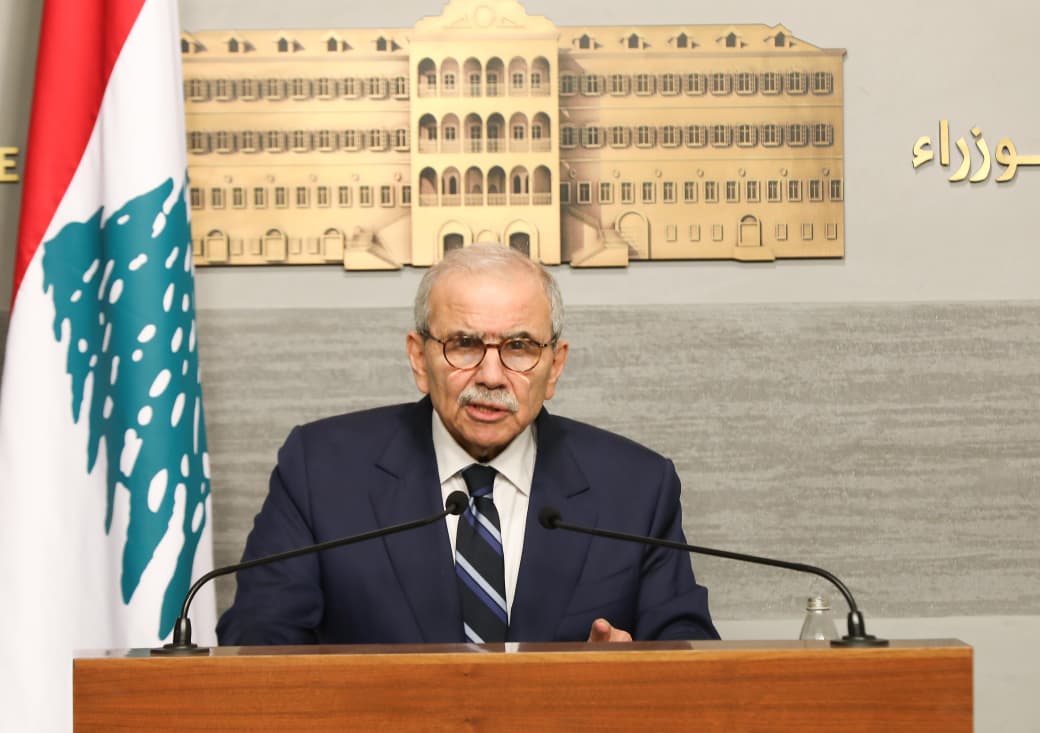
Prime Minister Nawaf Salam delivered a speech emphasizing that Lebanon is under immense strain due to a harsh war, which has forced hundreds of thousands of citizens to flee their homes and caused widespread destruction. He highlighted that this conflict was not chosen by the Lebanese people, particularly the residents of the South, who are paying the heaviest price in lives, livelihoods, and security. The impact of the aggression has not been limited to specific regions; it has affected all of Lebanon.
Salam underscored that Lebanon faces a harsh regional reality, caught between uncontrolled adventures and regional entanglements that do not serve the country’s national interest, alongside continuous Israeli attacks that violate its sovereignty and worsen the people’s suffering. Amid these challenges, the government’s primary duty is to protect Lebanon and its citizens and to uphold the supreme national interest.
He stressed that this phase cannot rely on distorting facts or demanding citizens remain silent when asking legitimate questions about how the country reached this point and how it can emerge from it. Respect for citizens’ suffering begins with honesty:
"The Lebanese state is the reference authority; it is present and active, providing shelters for our displaced citizens, ensuring they are supplied with fuel, water, food, and healthcare around the clock. It is also working with Arab brothers and international partners to mobilize all efforts to stop the war as quickly as possible and provide all necessary aid."
Salam condemned attempts to shift blame from those responsible for dragging the country into war onto the state, calling such efforts a transparent attempt to evade accountability and divert attention from the destructive consequences of the war.
"It is no longer acceptable to distort facts or blame the state. The state did not make the decision for the first or second military support operations, which led to more destruction, displacement, and vulnerability while leaving the state—and all Lebanese—to bear the responsibility."
He highlighted the dangers of hate speech and vindictive rhetoric, which he described as poisonous to national unity and increasingly taking the form of threats, calls for violence, and attempts to undermine state authority:
"This kind of speech is completely unacceptable. It is an attempt to silence the Lebanese people and prevent questions about accountability. Such rhetoric threatens internal stability and ultimately benefits Israel. Defending the state is part of defending Lebanon itself."
Salam emphasized that protecting Lebanon requires restoring state authority over war and peace and detaching the country from regional conflicts that exceed its national interest.
"Linking Lebanon to larger regional calculations does not protect it; it increases costs and gives Israel a pretext to expand its aggression. Lebanon’s priority today is to stop the war, halt destruction, end displacement, protect civilians, enable their return, and launch reconstruction."
He concluded with a call to unity, equality, and state authority:
"Restoring the state is not against anyone; it is protection for everyone. Lebanon cannot survive as a divided state or a partially controlled arena. Restoring the state means returning decision-making to its rightful place under one roof, one reference, one law, and one army."
"Lebanon belongs to all its citizens. It embraces everyone equally and guarantees equal rights and duties. No one is above the state, no one outside it, and no one can monopolize nationalism or define Lebanon alone."
"The state continues to restore its role, assert its authority, and enforce the law equally. This is a moment of responsibility, a moment to protect Lebanon, a moment to restore the state as a single reference for all Lebanese, the sole guarantor of their security, future, and sovereignty."
Long live Lebanon. Eid Mubarak to all.