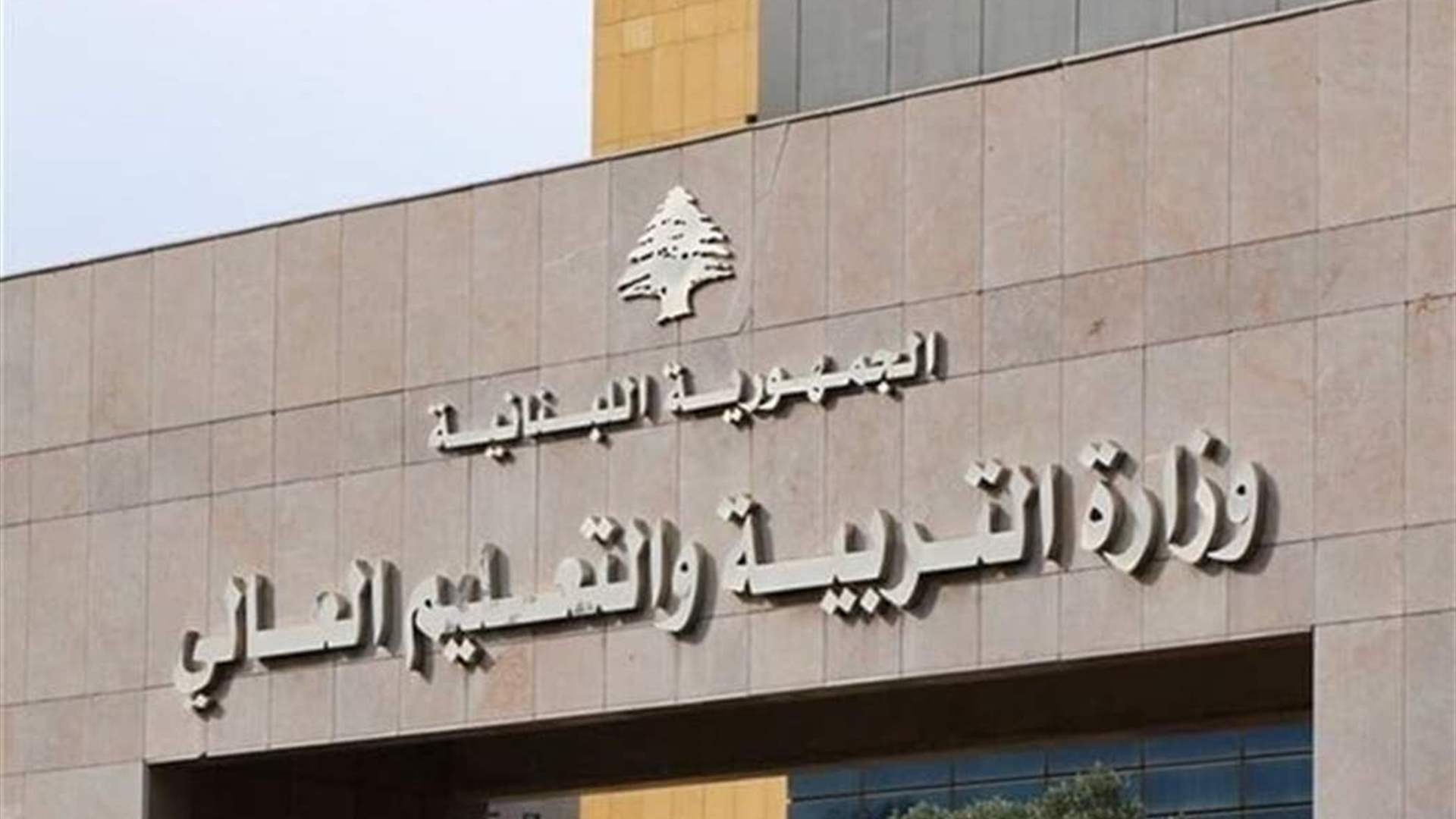
The Ministry of Education and Higher Education announced in a statement that, since the start of the aggression against Lebanon, it has found itself “facing major challenges, beginning with the responsibility of having its schools and secondary schools host our displaced people on the one hand, and the responsibility of ensuring the continuation of education for students on the other. From this standpoint, the Ministry of Education has worked around the clock like a beehive, with the aim of limiting the educational losses that Lebanon’s students may incur and the repercussions this could have on their future. A workshop was launched, mobilizing its administrations, educational districts, and school and secondary school principals across the country, to reach solutions that would reduce learning loss to the minimum possible, especially in public schools and secondary schools, whose students and teaching staff have borne the greatest share of the harm resulting from the attacks.”
It added: “Today, in light of this new reality facing public education in Lebanon, and after more than a month since the start of the aggression, the Ministry of Education finds itself responsible for presenting public opinion with the current educational reality, after days and nights of work and effort, and adopting flexibility in dealing with this reality, in order to shed light on where we have arrived:
First: The percentage of public schools and secondary schools that have managed to continue in-person education in a number of safe areas has reached around 50 percent of the total number of these schools, while distance learning has been adopted for all those unable to continue in person.
Second: The percentage of schools and secondary schools that have been completely unable to continue education because they are located in areas directly affected by the war constitutes only 15 percent of the total number of schools and secondary schools.
Third: The Ministry of Education, in cooperation with school and secondary school principals, is working to reach the students and teachers of these schools one by one, by surveying their names individually, in order to determine their circumstances and needs and assist them by all possible means.
Fourth: The ministry’s plan called for relying on distance learning for displaced students on the one hand, and students whose schools have been turned into shelters and whose return could not be secured on the other.
Fifth: To facilitate distance learning, the Ministry of Education worked to activate the accounts of teaching staff and students on the Microsoft Teams platform and provide free internet packages to facilitate its use.
Sixth: The ministry, in cooperation with the Center for Educational Research and Development, worked to provide digital educational material that students can access through the ‘Madrasati’ platform, and to activate the free ‘Call and Learn’ communication service with any teacher for any subject.
Seventh: The ministry worked to launch a number of Teaching and Learning Hubs by forming clusters of schools close to one another within a defined geographic range not exceeding 5 kilometers, and securing suitable spaces for learning and teaching.”
It stressed that the goal is “for there to be, near each of these groups, a center or building for learning and teaching to support this process; to enable teachers to use them by benefiting from the internet, educational resources inside them, and equipment; to make them a space for consultation and exchange of expertise among teachers; to enable students to participate in activities that can be organized by partners in these centers, especially students with special needs; and to provide a space for receiving and distributing any educational resources, including electronic devices and others, when available through donations. As for official examinations, the Ministry of Education, based on its close engagement with and assessment of the educational reality, the experience it has accumulated in confronting crises, and its possession of data on the situation of students in official certificate classes, especially the Lebanese Baccalaureate, in all public and private schools and secondary schools in Lebanon, will once again place public opinion in the picture regarding any decision it takes based on this reality, in cooperation with those in charge of these educational institutions.”
It continued: “In light of the above, the Ministry of Education and Higher Education wishes to call on all its local and international partners, educational activists in all regions, municipalities, local and international associations, as well as political, party, and social figures and authorities, to communicate and coordinate with it ‘exclusively’ regarding any initiative to support the continuity of learning plan in public schools and secondary schools, whatever the form of this initiative may be (providing buildings, devices, or otherwise), through the following link: partnerships@mehe.gov.lb. This step would help the Ministry of Education unify visions in the interest of students on the one hand, and work in the spirit of the state and its institutions under the umbrella of the ministry’s plan on the other, especially under these circumstances in which we are in dire need of reinforcing the concept of state institutions working to care for citizens’ affairs, away from the notions of patronage, clientelism, and quota-sharing, which this government is working toward and for.”