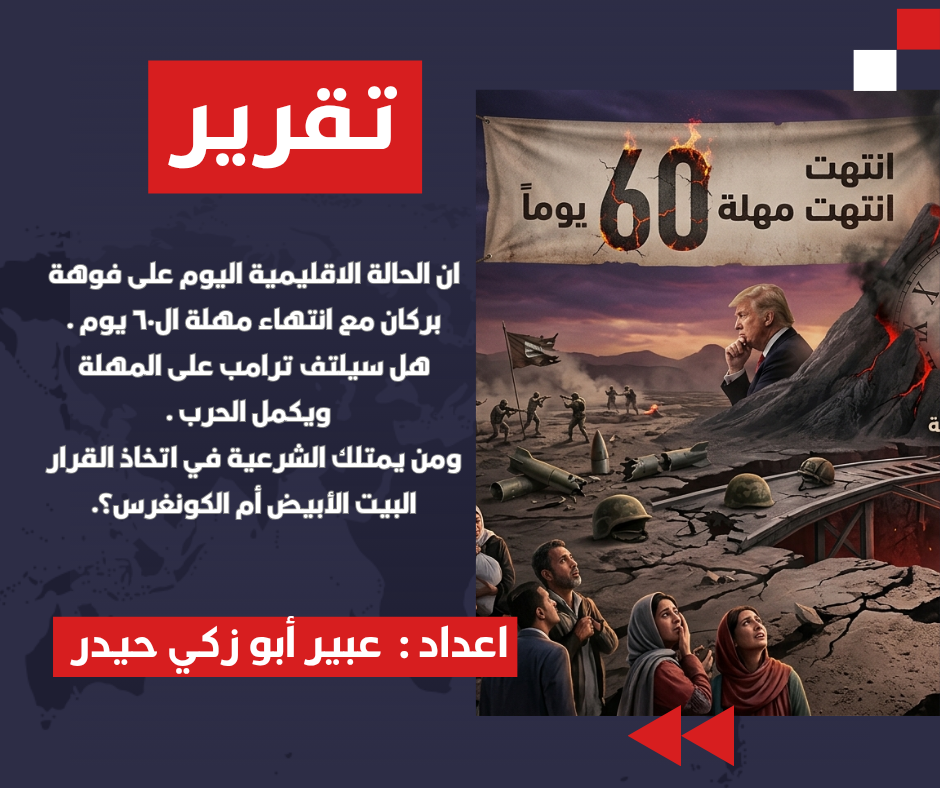
The regional situation today is extremely sensitive, bringing back to the forefront in Washington the old-new debate over who holds the power to declare war or halt it: the White House or Congress?
A question that may seem theoretical in times of peace, but turns into a complex equation when the possibility of using force emerges, placing the American constitutional system before a delicate test of its ability to reinforce its balances.
The framework governing this debate is what is known as the War Powers Resolution, which grants the president room for swift action to deploy forces, but obliges him to notify Congress within 48 hours and imposes a time limit of no more than 60 days for continuing operations without legislative authorization.
However, this law, enacted after the Vietnam War to curb the momentum and tendencies of the executive branch, has proven more flexible in practice than in text, as previous U.S. administrations have grown accustomed to broadening its interpretation in line with their strategic calculations.
Historically, moments of national shock have served as a gateway to expanding presidential powers, much as President Trump appeared to rely on something similar in the preemptive strike on Iran aimed at toppling the regime. For example, in the aftermath of the September 11 attacks, Congress approved a broad authorization for the use of force, which later became a legal umbrella for military operations extended across geography and time. The same scenario was repeated with the authorization for the invasion of Iraq in 2002, after which calls emerged within Congress demanding a review of those powers granted under exceptional circumstances and used in different contexts.
Today, the path to any new authorization runs not only through legal texts, but through a political minefield in the Senate, because the filibuster rule stands like a sword cutting off any attempt at passage. Securing 60 votes to end debate means, in practical terms, that a simple majority is not enough, and that any decision on war requires broad political cover that transcends partisan divisions. In light of sharp polarization, this condition becomes a structural obstacle, not merely a procedural detail.
Based on the political scene and the existing reality, the personal dimension of President Donald Trump emerges as a factor that cannot be ignored. The legal challenges surrounding him do not negate his constitutional powers as commander in chief of the armed forces, but they do weaken the level of his political legitimacy and complicate his ability to build an alliance within Congress. In a system based on the balance of powers, powers alone are not enough; political trust is also required, and that is difficult in a climate of acute division.
If legislative authorization is considered the formal path, Congress retains a more decisive tool: funding. Its power over the budget gives it the ability to stop any military operation or redirect it, even after it has begun.
Funding is the instrument that constitutes one of the pillars of effective oversight over military decision-making, and it is often used quietly and away from the spotlight.
Judicially, however, the courts keep a measured distance from this conflict. Although the Supreme Court of the United States has the final constitutional word, it has traditionally tended to avoid direct involvement in war disputes, preferring to leave room for the executive and legislative branches to manage their disagreements within what are known as “political questions.”
Despite all of the above, public opinion cannot be overlooked. It has become more cautious about external military engagement, especially after the Iraq War and the human and political costs it left behind. This is directly reflected in the calculations of members of Congress, who realize that voting for war is no longer a technical decision, but an electoral risk.
Today, with the legal deadline stipulated in the War Powers Resolution having expired without an explicit authorization from Congress, the crisis enters a pivotal phase carrying several possible scenarios:
First, strict compliance with the law, which would require the administration to adhere to procedures for withdrawing or reducing operations to a minimum during the technical extension period of 30 days. While this would amount to compliance with the constitutional text, politically it would be interpreted as a retreat.
Second, continuing operations while reinterpreting presidential powers, that is, considering the military moves to be limited or defensive. This is an approach previous administrations have resorted to, but it opens the door to a direct confrontation with Congress and perhaps legal challenges.
Third, a belated effort to obtain legislative authorization, in an attempt to contain the political and legal repercussions, despite the difficulty of securing broad consensus amid the existing partisan division.
Fourth, Congress resorting to the weapon of funding in order to impose immediate restrictions on operations, which could lead to an institutional crisis and perhaps a clash with the executive branch.
Accordingly, the expiration of the deadline set by Congress does not appear to mark the end of the war option so much as it opens a more complicated chapter, where legal texts intersect with political realities. While the Constitution grants the president the ability to move quickly in decisive moments, Congress still retains the ability to redraw the boundaries of that movement, in a fragile balance that may shape the coming phase not only through military decision-making, but across the American political system as a whole.