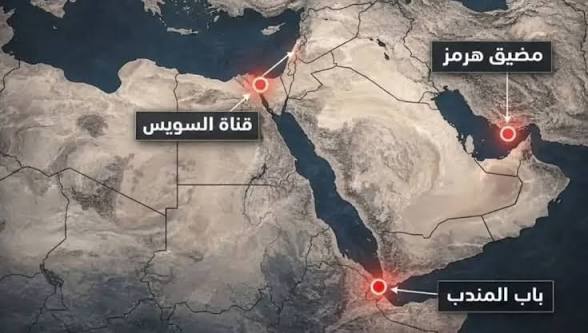
Military developments in the region are no longer merely an exchange of messages between rival parties; they now carry signs of a more dangerous phase that could redraw the map of conflict in the Middle East. As tensions escalate, with the bombing of Sanaa airport and the Houthi responses and threats that followed, the specter of regional war has once again cast its shadow over the region through the gateway of vital maritime corridors.
The Houthis’ announcement of their intention to close the Bab al-Mandab, in parallel with tensions linked to the Strait of Hormuz, places the world before an extremely sensitive equation. These two waterways are not merely geographic passages, but essential arteries for global trade and energy supplies. Any prolonged disruption to them could directly affect the global economy, oil prices, and international supply chains.
But the central question remains: Are we facing a full-scale regional war, or merely a new round of military and political pressure within carefully calculated rules of engagement?
The reality is that the region stands at a delicate moment. Saudi Arabia, which has for some time sought to consolidate stability and open political pathways on several fronts, now finds itself confronting security challenges tied to cross-border threats. Meanwhile, the Houthis are trying to use the leverage available to them to assert their presence in the regional equation, drawing on Yemen’s strategic position overlooking one of the world’s most important maritime routes.
Yet any move toward closing the Bab al-Mandab would not be seen as a local event; internationally, it would be read as a direct threat to global navigation and could prompt major powers to intervene to protect their interests, raising the likelihood of the confrontation expanding and slipping out of control.
From this perspective, the real danger lies not only in the exchange of military strikes, but in the chain of miscalculations that could drive the parties toward an escalation that no one wants. Previous experiences in the region have shown that a small spark can turn into a broad crisis when international and regional interests become intertwined.
By contrast, the diplomatic track remains the most difficult test for all parties. War, whatever its objectives, does not produce lasting solutions; rather, it opens new doors to humanitarian, economic, and security crises.
Today, the Middle East stands at a crossroads: either contain the escalation through political understandings that prevent a wide-scale explosion, or slide toward a confrontation that could stretch from the shores of Yemen to the Gulf and beyond.
Between Hormuz and Bab al-Mandab, what is being tested is not only the strength of the conflicting parties, but also the ability of the international community to prevent the region from entering a new war whose repercussions may extend far beyond the geography in which it began.
تابع آخر الأخبار أولاً بأول على قناتنا في واتساب
تابعنا