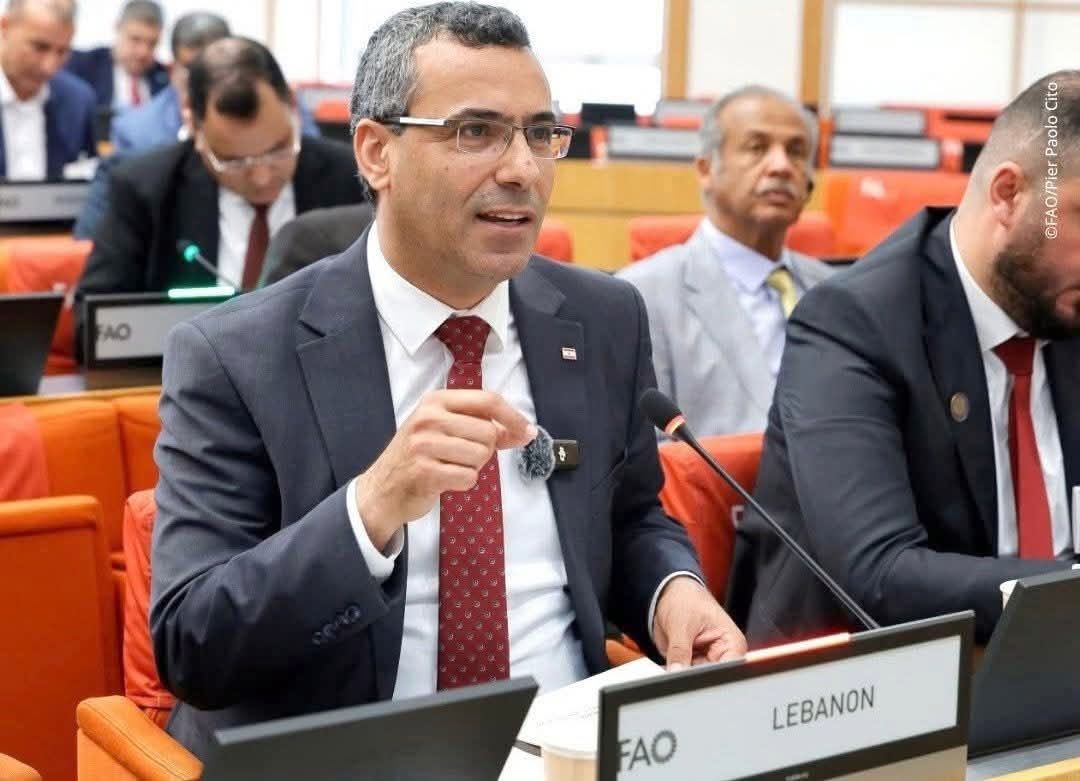
In a pivotal regional stop reflecting the scale of the challenges facing food security in the region, the 38th session of the Near East Regional Conference at the ministerial level opened at the headquarters of the United Nations Food and Agriculture Organization in the Italian capital, Rome, with broad participation from agriculture ministers and decision-makers from across the region.
Lebanon was represented at the conference by Minister of Agriculture Dr. Nizar Hani, accompanied by Lebanon’s Ambassador to Italy, Clara Al-Jazzar, and his adviser, Fadi Ghanem. The Lebanese delegation brought to the regional platform the voice of the national agricultural sector and its challenges under exceptional and unprecedented circumstances.
During the opening session, FAO Director-General Qu Dongyu stressed that the escalation of conflicts in the Middle East during 2026 is placing enormous pressure on fragile agri-food systems and global supply chains, directly threatening food availability and affordability. He underscored the need to preserve the smooth flow of global trade and ensure food reaches all countries, especially those heavily dependent on imports.
The conference was held at a critical moment for the region. Chaired by the United Arab Emirates, represented by the Minister of Climate Change and Environment, it brought together ministers and officials to discuss the intertwined challenges affecting food security and the sustainability of agricultural systems amid overlapping crises including conflict, climate change, and economic pressures.
Hani: Agriculture is a pillar of sovereignty and national resilience
In his address to the conference, Lebanese Agriculture Minister Dr. Nizar Hani said that agriculture in Lebanon goes beyond being merely an economic sector, describing it as “a pillar of national resilience, a symbol of sovereignty, and a guarantee of social stability,” stressing that “agriculture is the pulse of the land and of life.”
Hani pointed out that Lebanon is facing worsening food security challenges, with the share of the population requiring urgent food assistance rising from 18% to 24% as a result of the war and waves of displacement that have reached around one million displaced people, nearly a quarter of the country’s population.
He also revealed the extensive damage inflicted on the agricultural sector, noting that about 22% of agricultural land has been affected, particularly in southern Lebanon, which forms the backbone of agricultural production and accounts for the largest share of banana, citrus, and tropical fruit output.
He explained that the cost of the war to the agricultural sector and food security through the end of 2024 was estimated at around $1 billion, a figure likely to rise as damage continues.
He noted that the losses were not limited to production, but also extended to natural resources, including forests, water, and soil, requiring many years of rehabilitation to restore environmental balance.
Call to strengthen international support and implement the agricultural strategy
Minister Hani stressed that Lebanon, despite its limited resources, continues to shoulder exceptional burdens beyond its capacity, calling for stronger international support and broader partnerships, particularly with the FAO, to bolster the resilience of the agricultural sector.
In this context, he outlined the main pillars of the National Agricultural Strategy 2026–2035, which is based on:
• Strengthening governance and partnerships and developing the institutional and digital framework
• Empowering farmers and fishermen and improving their livelihoods
• Sustainable management of natural resources and adoption of nature-based solutions
• Developing agricultural value chains and enhancing their competitiveness after recovery
• Modernizing agricultural infrastructure and irrigation systems and strengthening adaptation to climate change
Lebanon’s message: Investing in agriculture is investing in stability
Hani concluded by emphasizing that supporting the agricultural sector constitutes a direct investment in food security and national stability, calling for international efforts to be integrated to ensure support reaches those who need it through transparent, science-based approaches that enhance the effectiveness and sustainability of the response.
This conference comes at a time when the need is growing for coordinated regional and international efforts to confront food security challenges, while Lebanon stands out as a special case requiring urgent support to preserve its agricultural sector as one of the pillars of national resilience.