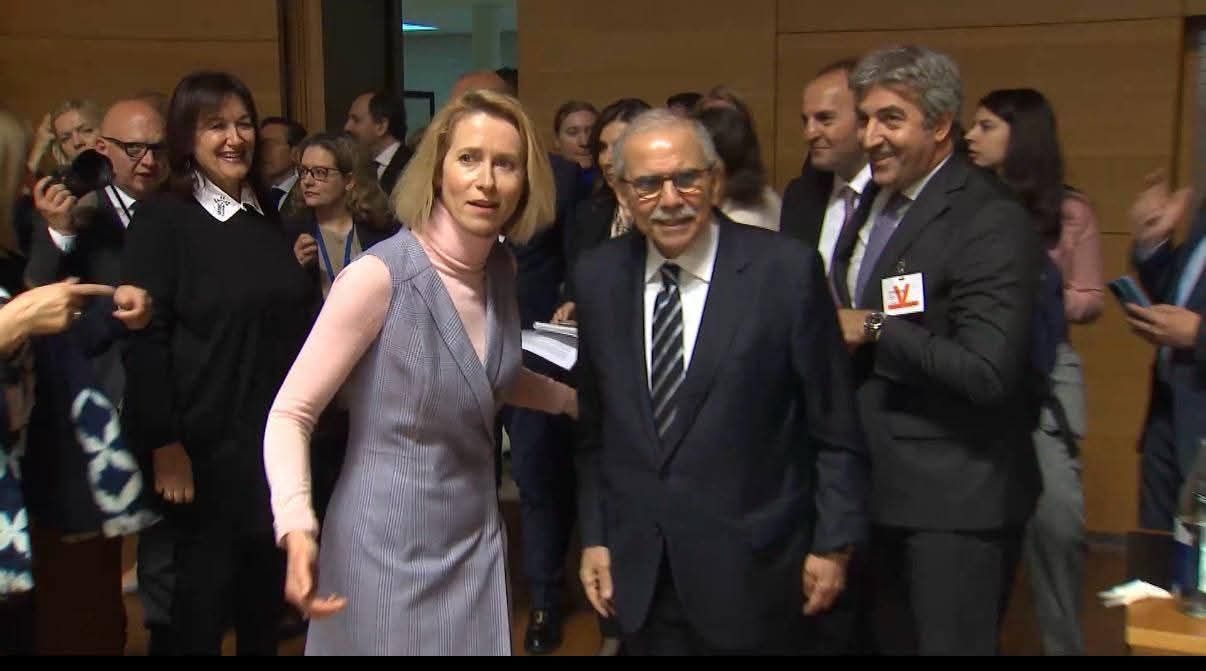
Speech by Prime Minister Nawaf Salam before the European Union Foreign Affairs Council in Luxembourg:
Your Excellency High Representative Ms. Kaja Kallas, Excellencies, distinguished participants, dear friends,
It is an honor to address you today, and I thank you for your warm welcome.
Allow me first to express my sincere gratitude to the European Union for this invitation, and more importantly for its continued support for Lebanon, especially in these difficult times it is going through.
Our long-standing partnership with you has always been a source of strength and reassurance for our people. The countries you represent have repeatedly affirmed their rejection of Lebanon being turned into an arena for regional wars or international conflicts, stressing instead that it is an independent and sovereign country, where the richness of pluralism is complemented by the principles of democracy and the rule of law. Rest assured that these principled positions are widely appreciated in Lebanon.
As we enter a new phase in Lebanon’s troubled history, following the ceasefire reached last week, we hope it will prove sustainable and put an end to the proxy wars that have burdened the country for many long years.
Today, we find ourselves in a war we neither sought nor chose. It is a war that has brought, and continues to bring, deep pain to our people and to sow fear in the hearts of our children.
Our nation has suffered from repeated conflicts, whether internal or imposed from abroad, that have drained our resources and weakened our capacities. This latest war has only compounded the scale of destruction, deepened our economic crisis, and threatened our social stability.
Ending this war has become an urgent necessity. The path to doing so lies in safeguarding Lebanon’s sovereignty—indeed, fully restoring it—and protecting its territorial integrity.
Yet achieving this goal requires an honest reckoning with the internal reality that has weakened the state for many years: a state that does not hold a monopoly over decisions of war and peace remains perpetually at risk.
It is time to entrench a clear and unequivocal principle: there can be no independent state without the attributes of sovereignty, and no sovereignty without a single legitimate authority that monopolizes national decision-making.
My government is committed to pursuing a clear and responsible path out of the current conflict. In this context, Lebanon recently engaged, in good faith, in direct preparatory talks with Israel under U.S. auspices in Washington.
For us, the choice of diplomacy is not a sign of weakness; rather, it is an expression of national responsibility aimed at leaving no avenue unexplored in restoring our country’s sovereignty and protecting its people.
Our goal is not symbolic engagement. On the contrary, we are determined to seize this opportunity to work toward a lasting solution.
Through this diplomatic track, my government seeks to end the occupation, secure the release of our prisoners, and ensure the return of the displaced to their homes and villages.
Moreover, our determination to establish the state’s monopoly on arms and put an end to regional interference in our internal affairs should no longer be in doubt. As you know, we have taken a series of decisive measures in this direction.
My government has recently begun implementing a plan to make Beirut a weapons-free zone, and we have banned Hezbollah’s military and security activities. We have also instructed the security forces to investigate Iranian Revolutionary Guard operatives working covertly on Lebanese territory and to arrest and deport them in accordance with applicable laws.
I would also like to recall that on August 5, 2025, the Lebanese government took a historic decision to task the Lebanese Army with drawing up a plan to enforce the state’s full monopoly on arms across all Lebanese territory.
On September 5, 2025, the army submitted this plan to my government, where we discussed it and welcomed it; and on January 8, 2026, the army announced the completion of its first phase by establishing operational control south of the Litani River, with the exception of areas still under Israeli occupation.
I also stress that, pending a lasting solution, UNIFIL soldiers must not become victims of this conflict. We are fully committed to ensuring their safety and security, and we strongly condemn any attack targeting them.
I take this opportunity to renew our heartfelt condolences to the French government and to the family of the soldier who recently lost his life, and we wish the injured a speedy recovery.
Excellencies and friends,
We have consistently called for full adherence to international law and international humanitarian law, based on our conviction that the values they embody are universal values to which we are committed, as are many countries, especially in Europe. They are part of the common good we share, and they must not be ignored or overlooked in any conflict or in any effort to resolve it.
Dear friends,
Lebanon today stands at a critical crossroads, weighed down by the burden of two wars in less than three years. Before the outbreak of this latest conflict on March 2, nearly one in three Lebanese was living below the poverty line; today, that figure has risen to more than 40% of the population. In less than a month, 40,000 housing units were damaged or destroyed, and more than one million people were displaced. Preliminary World Bank estimates, covering only the first month of the conflict and before the April 8 escalation, indicate that damage to infrastructure and housing reached $1.4 billion, including $1 billion in the housing sector alone.
The overall economic impact has been severe: the economy is expected to contract by 7.5% in real GDP this year, while inflation has reached around 15%.
A ceasefire has recently been announced, but the next phase will be no less difficult—only different in nature. While some of the displaced will return immediately, others will wait cautiously for conditions to stabilize.
At this stage, the role of the state emerges as indispensable. We must provide support to those who have lost their livelihoods, expand social safety nets to include those who were already suffering before the war and whose conditions worsened afterward, and create job opportunities that ensure a sustainable recovery.
We must also begin rehabilitating damaged infrastructure and housing, support municipalities in meeting basic needs, restore access to health services, strengthen the capacities of hospitals and primary healthcare centers, and ensure continuity in education by rehabilitating schools that were damaged or used as shelters.
In addition to the cost of recovery and reconstruction, relief costs are estimated at around $500 million for the first year.
In this context, we express our deep gratitude to the European Union for providing €100 million in humanitarian aid for the emergency response, in addition to €1 billion in development assistance for the 2024–2027 period.
For our part as a government, we are committed to intensifying every possible effort to ease the burdens borne by more than one million citizens. That is why rebuilding trust in public institutions is a priority.
As Jean Monnet said: “Nothing is lasting without institutions.”
Accordingly, the absence of strong and effective institutions makes Lebanon’s recovery unattainable. I therefore affirm that my government is moving ahead with implementing the reform program it announced about 14 months ago, in the understanding that Lebanon’s recovery requires:
• A credible framework for restructuring the financial sector.
• A fair treatment of depositors’ bank deposits and the restoration of the banking sector’s effectiveness.
• And last but not least, stronger fiscal discipline and the entrenchment of good governance.
The scale of the challenges we face is immense and calls for greater international solidarity. Lebanon today needs its European partners more than ever:
First: in continuing to support us in confronting this unprecedented humanitarian crisis.
Second: in strengthening support for the Lebanese Army and the Internal Security Forces, particularly through the European Peace Facility program. The equation is clear: the stronger the Lebanese Army, the weaker the illegitimate armed groups.
Third: in supporting recovery and reconstruction efforts, as the cornerstone of long-term stability in Lebanon—and in the region more broadly.
Thank you for your kind attention.