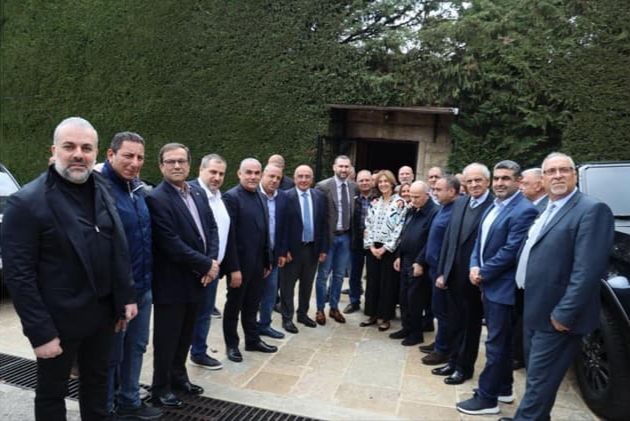
Head of the Democratic Gathering bloc MP Taymour Joumblatt, accompanied by MPs Wael Abou Faour and Raji Al-Saad, and Secretary-General Zafar Nasser, visited former MP Fares Said, head of the Saydet al-Jabal Gathering, at his residence in Qartaba. Said hosted a luncheon in their honor, attended by the head of the Jbeil District Municipalities Union and mayor of Qartaba, Fadi Martinos, along with a number of district mayors.
During the meeting, Said welcomed the delegation, speaking of the “friendship that binds this house to the Joumblatt family,” and said: “We will remain friends. The importance of this visit at this particular moment comes as many are casting doubt on the unity of this country and thinking that if sects lived on their own, they would be able to manage their affairs. Some speak of a small Lebanon and seek to cast doubt on coexistence and the Mountain Reconciliation, in which Walid Bey and the late Patriarch Nasrallah Sfeir played the greatest role, while we were among those who helped bring it about.”
He added: “Some tell us every day that the country is under control yet not cohesive, and they look toward rebuilding the Lebanese formula. From this Maronite home in Mount Lebanon, I affirm to you that we stand with the Lebanese Constitution, the Taif Agreement, coexistence, and Greater Lebanon. We do not consider living with Muslims a source of danger; on the contrary, it is a source of richness for Lebanon.”
He continued: “We live in a mixed area where there have never been problems of a sectarian nature, but rather disputes over property and politics. In the current circumstances we are living through, there is no alternative to negotiations in order to find a solution to the existing crises.”
He went on: “In 2023, the support war was launched. In 2026, it led to the occupation of around 600 square kilometers of Lebanon, the displacement of one million citizens from the Shiite community, and the devastation of more than 109 villages to date. All these problems can only be resolved through negotiations.”
He said: “This is the first time in a long while that we are negotiating in our own name. This negotiation needs national backing, and I believe your house, with what it represents as a point of support and balance in the country, has a major role. Your party has a major role in reformulating an inclusive national project that today embraces the initiative of President General Joseph Aoun and Speaker of Parliament Nabih Berri, so that we go into these negotiations without being divided among ourselves.”
He added: “The side concerned with the war must understand that bearing the cost of its relationship with the Lebanese, however great, is far less than the cost of separating from Lebanon and giving priority to drawing strength from an external power. When we went to the Mountain Reconciliation, we knew its major problems, and that this reconciliation was forbidden to us during the era of Syrian tutelage, yet we carried it out. Today, I urge you to use your capacity and your relations with all Lebanese parties, across sects and political, religious, and partisan affiliations, to help reunite the country and formulate a national project around the initiative currently on the table for negotiations with Israel to find a solution to the situation in Lebanon.”
For his part, Joumblatt thanked Said for the استقبال, pointing to the “historic relationship linking the Joumblatt family to this venerable political house,” and said: “It is true that the Lebanese composition is more complicated than necessary. Unfortunately, no one can transcend history, and unfortunately we all paid the price during the civil war. I wish I had sat down with you, Dr. Said, before our tour of Lebanon’s parties. Given the understanding and information you possess about Lebanon’s composition and history—more than all the parties—we could have spared ourselves a great deal.”
MP Raji Al-Saad, meanwhile, stressed that “the Taif Agreement is the cornerstone of Lebanon,” saying: “When we try to move away from it, we lead the country into labyrinths we can well do without.”
He spoke of the “shared struggle since the Bristol Gathering and March 14, 2005,” adding: “When there is a political banner that resembles us and brings us together away from sectarianism, we achieve results. When we move away from this banner, we lose the battle. The compass we have, and all our visits, are an attempt to unify viewpoints as much as possible in order to find common ground for all those who think like us, and also to communicate with those who share the same headings, leading ultimately to Lebanon’s salvation.”
He concluded: “It is true that this phase is difficult and very delicate, but there is no salvation for Lebanon unless we unite around the national principles we have spoken about.”
After the meeting, Joumblatt and the accompanying delegation, together with Annaya-Kfarbaal Mayor Mark Abboud, moved on to the Monastery of Saint Maron in Annaya, where they were received by the Superior General of the Lebanese Maronite Order, Abbot Hadi Mahfouz, and the monastery’s superior, Father ميلاد طربيه.
The delegation toured the monastery grounds and visited the shrine of Saint Charbel, before concluding the visit with Father Mahfouz presenting those in attendance with a relic of Saint Charbel.