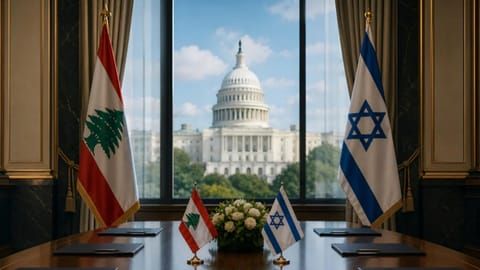
The Lebanese file remained in focus for a second day in Washington, unaffected by U.S. President Donald Trump shifting the global spotlight to China for two days as well.
The third round of Lebanese-Israeli negotiations, held under U.S. sponsorship at the State Department headquarters in Washington, concluded with what the participating Lebanese delegation described as tangible diplomatic progress in Lebanon’s favor. The parties agreed to extend the current ceasefire for an additional 45 days, to allow room for the launch of a U.S.-sponsored security track on May 29, with the participation of military delegations from Lebanon and Israel, as part of efforts aimed at consolidating calm and strengthening security arrangements along the border, as well as reinforcing the political momentum achieved in recent days.
Those present also agreed on a joint statement from the U.S. State Department as a form of “unity of position,” in which Washington expressed hope that “these discussions will contribute to achieving lasting peace between the two countries, full recognition of each other’s sovereignty and territorial integrity, and the establishment of real security along the shared border.” U.S. diplomatic sources indicate that Washington is testing a more ambitious negotiating formula than any before: pushing Lebanon and Israel toward a parallel political and security framework, while the issue of disarming Hezbollah shifts from a deferred item to the condition that will determine whether diplomacy moves forward or reverts to the logic of temporary truces and reciprocal strikes.
The U.S. State Department spokesperson described the round as more positive than expected and reflective of the seriousness of the progress made. He also stressed that the goal is to create space to sustain that seriousness, despite the continued clashes and shelling in southern Lebanon and the Bekaa, whether through Israeli airstrikes or Hezbollah drones and rockets. According to the State Department, what was achieved on Friday is a tangible development paving the way for a broader track.
Follow-up from Baabda
The presidential palace had been monitoring the ambassador-level rounds of negotiations between the Lebanese and Israeli delegations under full U.S. State Department sponsorship. President Joseph Aoun mobilized from early morning through a series of political and technical consultations, beginning with a phone call with Parliament Speaker Nabih Berri, during which he briefed him on Thursday’s round of negotiations. Berri stressed the priority of a ceasefire and informed Aoun that he would speak to Hezbollah if Israel complied. The president also contacted the prime minister. On the technical side, consultations with the support cell, specialists, and the Lebanese delegation in Washington addressed the latest developments and conveyed the necessary instructions and directives.
What stood out in what President Joseph Aoun was told by Speaker Berri during the phone call was that Hezbollah would commit to a full ceasefire if the Lebanese delegation succeeded in securing a similar commitment from the Israeli side, according to MTV information.
In the same context, a meeting was held in عين التينة between Berri and Prime Minister Nawaf Salam, during which they reviewed the general situation and the political and field developments in light of Israel’s continued aggression against Lebanon, particularly in the south and western Bekaa, and its violations of the ceasefire.
The negotiation round
According to sources cited by Nidaa Al-Watan, the second evening session on Thursday night witnessed “back-and-forth” exchanges between the Lebanese and Israeli sides, and this continued into Friday’s session. Discussions focused on two tracks, military and political. For the second consecutive day, the Lebanese delegation stressed the need to consolidate the ceasefire, avoid targeting civilians, and halt the bulldozing of villages and systematic destruction. On the other hand, the discussion addressed the “demand” to link Israeli withdrawal to the disarmament of Hezbollah. The Lebanese delegation’s response was that the priority is a ceasefire, a truce, and guarantees of Israeli withdrawal. As for Hezbollah’s disarmament, that is a Lebanese matter to be discussed internally and would come after Israel’s full withdrawal.
The sources confirm that communication between Baabda and the Lebanese delegation in Washington followed every detail, amid renewed emphasis from President Aoun on Lebanon’s constants in the negotiations. Yesterday’s session saw the discussion reach the point of heated tension, prompting the U.S. side to intervene several times to put the talks back on track. While the atmosphere was not encouraging at the start of the negotiations, it improved after the U.S. intervention, which sought first to reach a security agreement between Lebanon and Israel before moving on to other details.
Washington atmosphere
According to the information, the U.S. administration considers the progress in the negotiations “important,” as it is no longer limited to consolidating the ceasefire. It is trying to reach a “security agreement” and is examining long-term security arrangements, particularly an “effective ceasefire” in exchange for a “genuine” commitment from Hezbollah.
Negotiations in the shadow of war
On the security front, the Israeli army continued its military pressure, entirely separate from the course of negotiations, with its aircraft striking most southern towns amid warnings issued by its spokesman Avichay Adraee, especially to residents of the city of Tyre and towns in its district. Israeli warplanes also intensified their raids on Nabatieh and towns in the district, causing further destruction and injuries. They directly targeted the Health Authority-Civil Defense center in Harouf in the Nabatieh district, killing three paramedics and critically wounding a fourth, while completely destroying the center. Overnight, Israel also struck the city of Tyre, targeting the building it had threatened at the Maarakeh junction at the northern entrance to Tyre, before launching a second strike on the city center. According to the Lebanese Health Ministry, the toll stood at 2,951 dead and 8,988 wounded as of May 15, 2026.
Nidaa Al-Watan
تابع آخر الأخبار أولاً بأول على قناتنا في واتساب
تابعنا