In recent weeks, President Donald Trump has spoken about a substance he says is essential to ending the United States’ war against Iran: “nuclear dust.”
According to the president’s account, Iran’s nuclear program was so badly damaged by U.S. bombs last year that all that remained under the rubble was a kind of powdery residue.
The phrase “nuclear dust” appeared designed to downplay what Trump is actually referring to: Iran’s stockpile of uranium enriched to near bomb-grade, stored in containers roughly the size of large scuba tanks.
This material is not, in fact, “dust.” It is typically a gas when stored inside the containers, though it turns into a solid at room temperature. It is volatile and highly toxic if it comes into contact with moisture, and if mishandled, it can lead to a nuclear reaction.
Trump’s phrase reduces the complex tasks of uranium enrichment, as well as the complications of negotiating an end to the war. It is also a term that nuclear experts say they have never heard before.
“I interpreted it only as Trump’s figurative way of speaking,” said Matthew Kroenig, senior director of the Scowcroft Center for Strategy and Security at the Atlantic Council.
Here is a closer look at what Trump means when he talks about “nuclear dust,” and why it matters to ending the conflict.
What is “nuclear dust”?
Trump is essentially referring to uranium that Iran has enriched to 60 percent, a level close to the 90 percent purity typically used to make a bomb.
Fuel enriched to that level has no practical use for purposes such as nuclear power generation. It is therefore seen as a warning sign to the international community that Iran could quickly convert the fuel to bomb-grade, although building a nuclear bomb after that would still require many more steps.
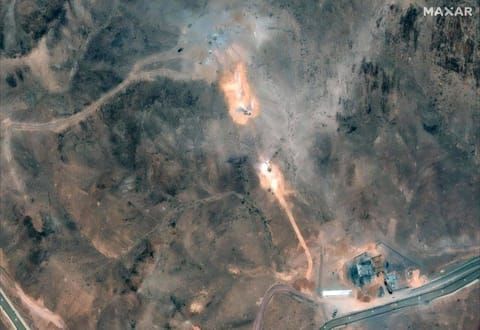
The United States bombed three main nuclear sites in June, including a complex outside Isfahan where a large portion of the near-bomb-grade material was believed to be stored.
“It is not yet bomb-grade, but it is on the way there, and it was stored at the nuclear facility in Isfahan,” Kroenig said. “So when Isfahan was bombed, that material is presumed to have been buried there.”
U.S. intelligence officials believe the Iranians dug to reach the material, although there is no evidence that any quantity of it was moved.
Uranium contains a rare radioactive isotope called U-235, which can be used to power nuclear reactors at low enrichment levels and fuel nuclear bombs at much higher levels.
The goal of uranium enrichment is to increase the proportion of U-235, often by passing it through gas centrifuges, machines that spin at supersonic speeds to increase the fuel’s purity.
Why does it matter to ending the war?
Trump has said Iran agreed to hand over its nuclear materials to the United States, but Tehran has denied the claim.
Speaking to a crowd in Arizona last week, Trump said: “The United States will get all the nuclear dust. Do you know what nuclear dust is? It’s that white powdery stuff that our B-2 bombers made.”
Iran’s enrichment levels have risen since Trump withdrew the United States from the Obama-era nuclear deal, the 2015 agreement known as the Joint Comprehensive Plan of Action, saying the deal was not tough enough.
Trump then imposed several rounds of U.S. sanctions on Iran. In response, Tehran repeatedly exceeded the strict limits the agreement had placed on uranium enrichment and began resuming production of nuclear material.
“They were enriching at very low levels before the Trump administration withdrew the United States from the nuclear deal,” said Justin Logan, director of defense and foreign policy studies at the Cato Institute, a libertarian-leaning think tank. “So what Trump calls nuclear dust did not exist inside Iran after the deal was signed or during its early months.”
Can the material be removed during the war?
Trump acknowledges that removing Iran’s enriched uranium would be difficult. He said this week on his Truth Social platform that “getting it out would be a long and difficult process.”
That may be nearly impossible without Iranian consent.
“This mission would take a very long time, and it would require a lot of technical experts who are not good at killing people,” Logan said. “So the idea of doing that with our swords drawn strikes me as crazy.”
He added that extracting the material during the war would be just as difficult for the Iranians.
“Trump is right to say that our eyes are over the target almost all the time, and that the Iranians cannot simply sneak in during the middle of the night and smuggle it out; it is highly volatile material,” he said. “We do not know the storage conditions underground. And those tanks it was stored in may not be in good shape. It would require a lot of technical experts on the ground. And that applies to the Iranians as much as it does to us.”