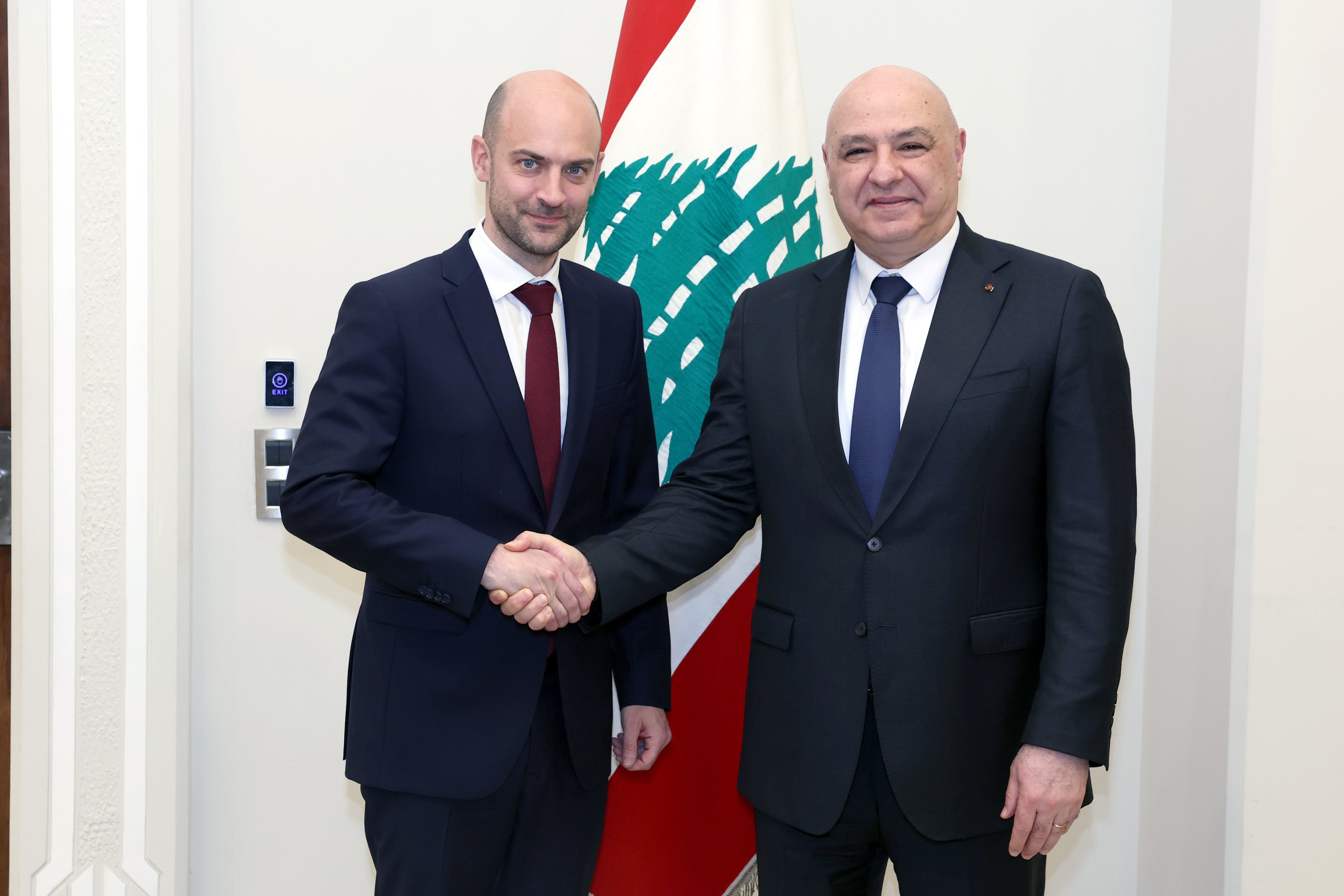
President Michel Aoun received this afternoon at 3 PM at Baabda Palace French Foreign Minister Jean-Yves Le Drian, in the presence of the French Ambassador to Beirut, Hervé Magro, and the accompanying delegation.
Minister Le Drian conveyed to President Aoun the greetings of French President Emmanuel Macron and summarized the French efforts to halt the military escalation in Lebanon amid ongoing Israeli attacks and fighting on its territory.
Le Drian expressed France’s readiness to work toward ending the military escalation through proposals being discussed with the relevant parties, based on President Aoun’s negotiation initiative, which the French minister described as “courageous” and supported by the international community, as it reflects a firm commitment to establishing a strong state that refuses to be drawn into a war it did not start.
The minister emphasized the role of the Lebanese Army in any solution to the current situation, as well as during the period following the end of the United Nations Interim Force in Lebanon (UNIFIL) mandate and its withdrawal. He also addressed Lebanese-Syrian relations in light of the trilateral call between President Aoun, President Macron, and Syrian President Ahmed Al-Shar, and what France can do to ensure continued coordination between the two neighboring countries.
President Aoun welcomed Minister Le Drian and his delegation, praising “the distinguished role played by President Macron in assisting Lebanon on various fronts, particularly through continuous communication with both the Lebanese and Syrian sides, as well as with the Israeli side.”
The President reiterated “the necessity of a ceasefire and providing the guarantees needed for its success by the concerned parties, stressing that the negotiation initiative he announced remains active, but the ongoing military escalation hampers its launch. This requires a halt to hostilities to create the appropriate conditions for negotiations, which are currently unavailable due to the widespread fighting, destruction of villages and towns in the south, hundreds of casualties, and over a million displaced persons. Once the ceasefire is in place, the negotiation mechanism can be activated anywhere agreed upon, as the priority is to stop the escalation.”
President Aoun reaffirmed “Lebanon’s desire to maintain international forces in the south to oversee the implementation of any agreement reached, or the presence of European units that have expressed willingness to continue peacekeeping duties in the south, regardless of the legal framework of their presence.”
In another domain, President Aoun confirmed that “the government continues to implement decisions regarding the monopoly of weapons, although military escalation has hindered the full execution of the plan set by the army command. All official facilities, Rafic Hariri International Airport, the Port of Beirut, and border crossings are under the supervision of Lebanese military and security agencies, while the army operates patrols and checkpoints across Lebanese regions to prevent armed displays and detain violators.”
He emphasized that the government is steadfast in its position that decisions regarding war and peace fall exclusively under the state’s authority.
Finally, President Aoun thanked France—its president, government, and people—for “their solidarity with the Lebanese people during these difficult circumstances and for initiating humanitarian assistance to the displaced Lebanese.”