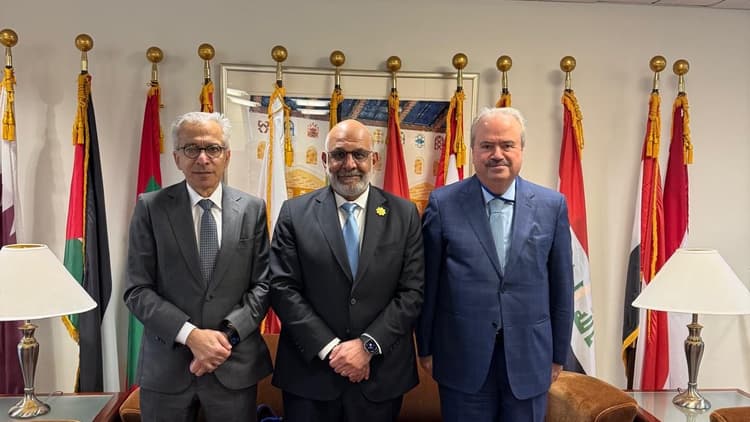
The Lebanese delegation taking part in the Spring Meetings of the World Bank and the International Monetary Fund in Washington, headed by Finance Minister Yassine Jaber, held a series of meetings with officials from the two international institutions, foremost among them a meeting with IMF executive directors devoted to discussing ways to support Lebanon at the current stage and the repercussions of the war, in addition to social protection files.
Jaber revealed that “a financing agreement worth $2 million will be signed on Wednesday with the World Bank to support the ‘Aman’ program run by the Ministry of Social Affairs, which will help strengthen assistance allocated to the neediest families.”
He explained that “the talks included examining the possibility of redirecting some aid toward needs imposed by the current circumstances, particularly relief-related needs, alongside technical issues linked to the need to prepare specialized studies to organize mechanisms for limiting economic and social damage, in light of the major changes Lebanon has witnessed over the past five years, in addition to the need to update existing coordination frameworks with international institutions in line with the new economic reality, as well as the necessary reforms capable of improving and enhancing the efficiency of public spending.”
He stressed that “the Lebanese delegation’s meetings will focus in a key part on addressing the losses Lebanon has incurred as a result of successive crises, and highlighting urgent needs and national priorities during the coming phase,” affirming that Lebanon’s participation in these meetings constitutes a key opportunity to convey the Lebanese state’s position to the international community and mobilize further technical and financial support, in a way that helps strengthen social and economic stability and support the groups most affected by the current conditions.
The Lebanese delegation had begun its meetings on the first day with a meeting with World Bank Regional Executive Director for the Middle East Abdulaziz Ibrahim Al Mulla and IMF Regional Director Ernesto Ramirez, during which they discussed the economic and financial repercussions of the war and their impact on Lebanon, assessed the effect of developments on financial and monetary stability, and discussed the rising economic cost of the current situation.
The delegation also held a meeting with European representatives from some of the main parties supporting Lebanon, addressing ways to redirect existing aid to meet urgent needs, amid the European focus on grants, direct assistance, and development and humanitarian programs, while emphasizing the continued support of European countries for Lebanon in the areas of relief, healthcare, education, and social protection, including support for the “Aman” program, cash transfers through the World Food Programme, and border management projects.
During the meetings, Jaber affirmed that “Lebanon, with the limited margins and capacities it possesses, has managed to preserve a minimum level of stability, but it faces challenges that exceed its own capabilities, which calls for concerted international efforts and the provision of exceptional support commensurate with the scale of the existing pressures.”
It was agreed to continue consultations during the upcoming meetings, with practical conclusions and recommendations to be prepared that include possible support tools and a preliminary path for addressing the economic cost of the war in comparison with available resources, in a way that contributes to strengthening Lebanon’s resilience and ability to recover.