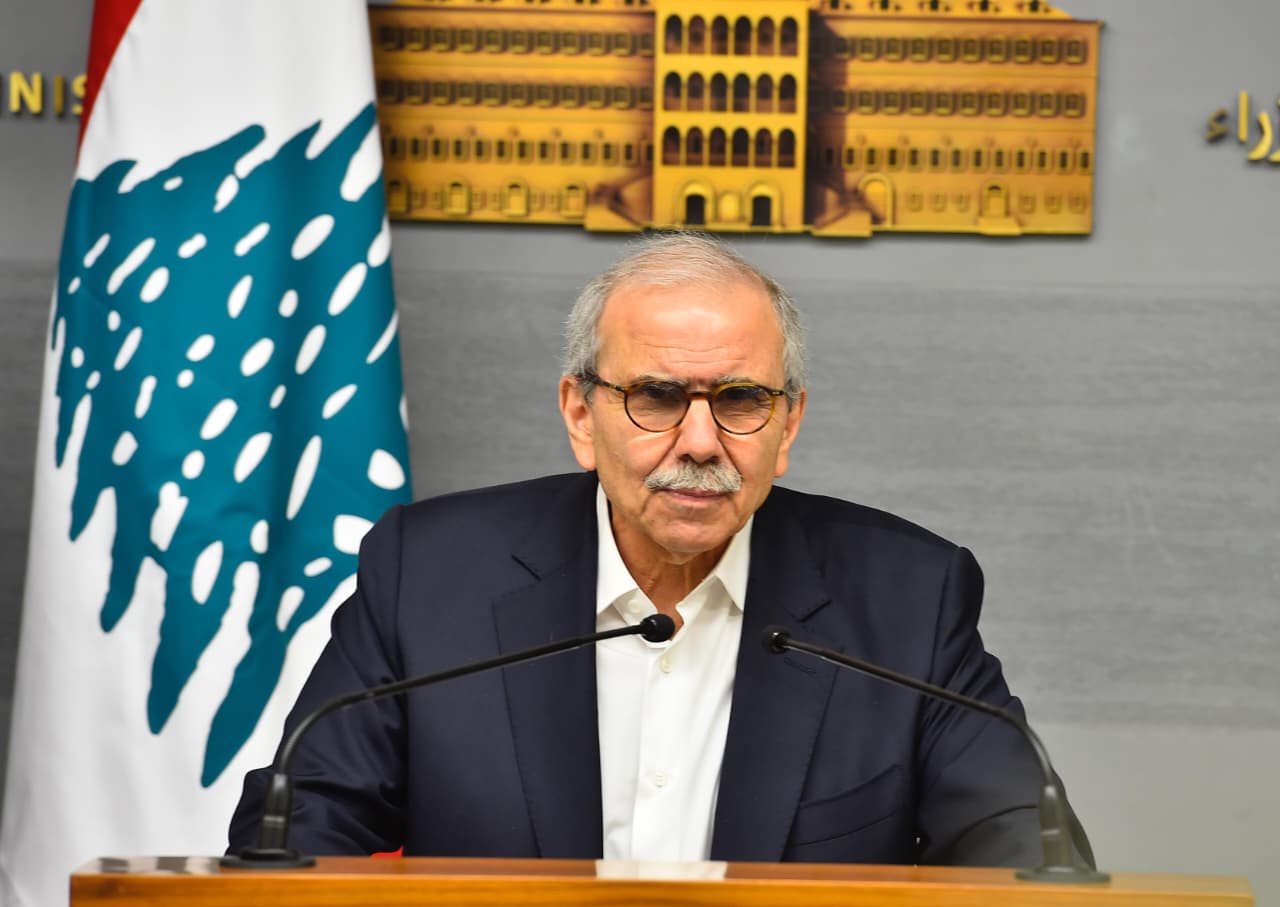
Lebanese Prime Minister Nawaf Salam said the Lebanese state made intensive efforts to prevent the country from sliding into war, stressing that Beirut repeatedly called for restraint and sought to avoid being drawn into the conflict.
In an interview with L'Orient-Le Jour, Salam explained that Lebanon had received prior assurances aimed at preventing escalation. According to him, Hezbollah had pledged not to intervene, while mediators conveyed Israeli assurances that no operations would be launched against Lebanon if the group stayed out of the conflict. However, these understandings collapsed within 48 hours.
The prime minister noted that Lebanon continues daily diplomatic efforts to mobilize Arab, European, and American support to stop the war. He added that the conflict is deeply tied to the broader confrontation involving Israel and the United States on one side and the Iranian regime on the other, while some Arab countries remain primarily focused on their own strategic interests and security concerns.
Salam also expressed appreciation for the humanitarian assistance provided by Saudi Arabia, which he said was the first to respond with aid, and praised the continued political and humanitarian support from France, recently reaffirmed by President Emmanuel Macron.
He indicated that there is currently no formal initiative to end the war, though several ideas remain under discussion, particularly from the French side. Salam also clarified that Lebanon has not received any guarantees linking a ceasefire to Hezbollah surrendering its weapons, stressing that the issue of arms is a long-term political process, while the immediate priority is halting the fighting.
Regarding potential negotiations with Israel, Salam said the Lebanese Cabinet had expressed readiness to resume talks within an internationally supervised framework that would include a civilian component. He noted that direct negotiations themselves have not been formally proposed and that Israel has not responded to Lebanon’s suggestion.
On Hezbollah’s future, Salam acknowledged that the group remains a political force represented in parliament with a broad popular base and control of numerous municipalities. He said that if Hezbollah were to fully transform into a purely political party and cease its military and security activities, the Lebanese state would have no issue with it.
Concerning the deployment of the Lebanese army, the prime minister affirmed that the government remains committed to its plan to ensure that all weapons across Lebanese territory are exclusively under state authority. While the war has disrupted parts of the implementation timeline, Salam insisted the government will not change its course.
He added that the Cabinet had already decided that Hezbollah’s military and security activities are now considered illegal, emphasizing that while the state does not seek confrontation with the group, it will not yield to pressure or intimidation.
Addressing criticism about the government’s credibility in enforcing its decisions, Salam argued that dismantling a military structure built over decades with substantial external funding cannot be achieved in just a few months, though he noted that gradual progress is being made.
On the broader political front, Salam reiterated that no one in Lebanon would accept peace imposed under Israeli conditions. At the same time, he reaffirmed Lebanon’s commitment to a just and lasting peace based on the Arab Peace Initiative adopted in Beirut about 25 years ago, founded on the principle of “land for peace.”
On the humanitarian front, Salam said the government had prepared for the worst-case scenarios and updated its emergency plans within days of the war’s outbreak. He added that Lebanon is now in a better position to provide shelter and assistance to displaced civilians, urging national solidarity with those affected by the conflict.
He concluded by noting that the only guarantees Lebanon has received so far concern avoiding strikes on Beirut–Rafic Hariri International Airport and the road leading to it.