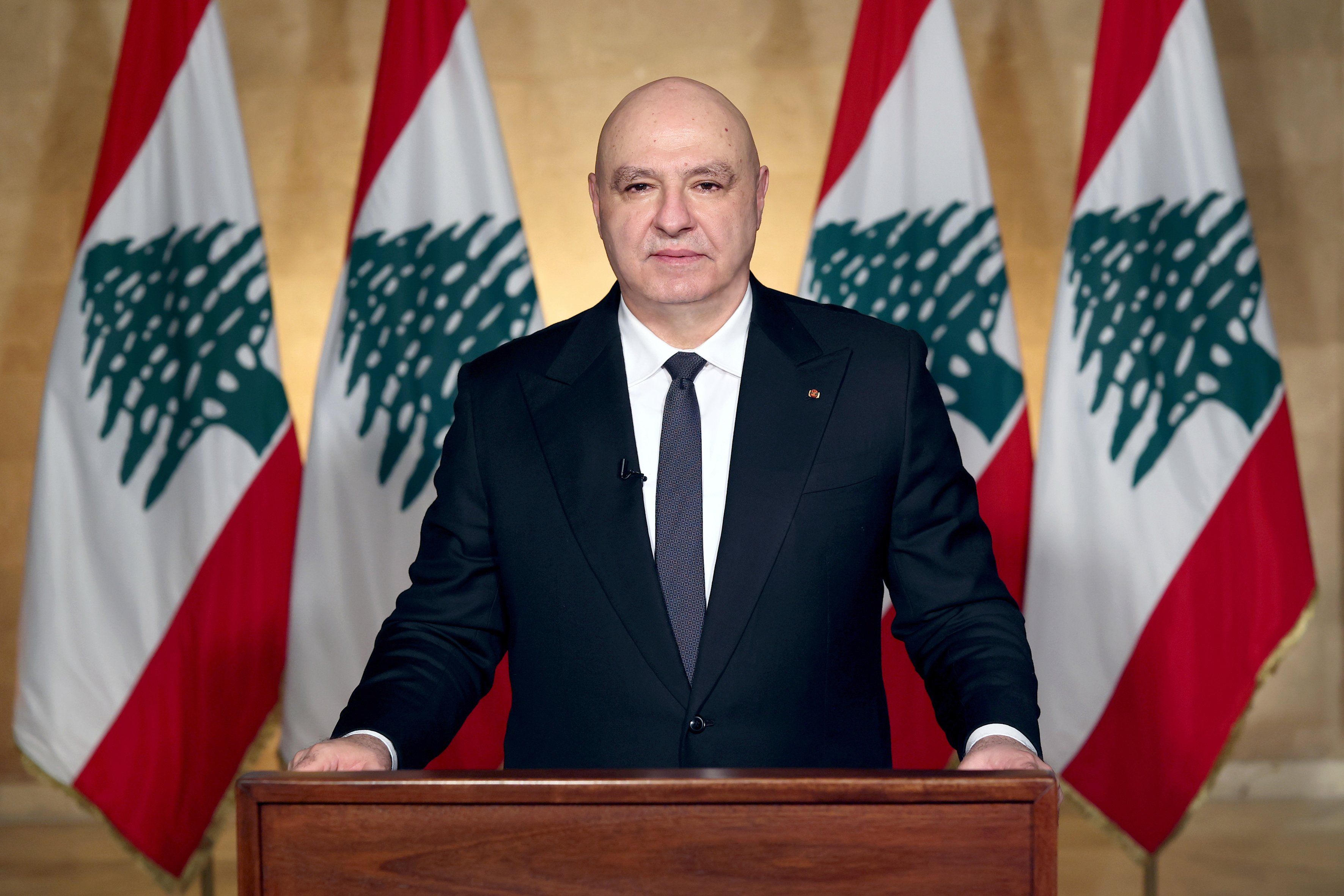
President Joseph Aoun affirmed that he is placing great hope in his upcoming visit to Washington and his meeting with US President Donald Trump, amid what he described as “the clear insistence of the US administration on supporting the path toward ending the war between Lebanon and Israel.”
Aoun said in an interview with An-Nahar: “The option of war has proven fruitless,” noting that “the goals set by Hezbollah are the same goals Lebanon put forward in negotiations with Israel under Washington’s sponsorship,” namely “withdrawal from the south, the recovery of prisoners, the return of bodies, and reconstruction.”
He explained that “the difference lies in the means,” stressing that “war is not a good option.”
Regarding the framework agreement reached in Washington, Aoun said it “is not the ideal agreement,” adding: “I had only two choices: either stand by and watch, or move toward a decision to negotiate.”
He pointed out that “the decision to negotiate has a 50% chance of success, especially since we have an American guarantor,” calling for “giving the framework agreement a chance,” and warning that “Israeli Prime Minister Benjamin Netanyahu always wants to muddy the waters.”
Hezbollah’s weapons and relations with the party
On the future of Hezbollah’s weapons, Aoun stressed that “as long as the party’s choice is Iranian, there will be no point,” affirming that “matters can be resolved when the party’s choice becomes Lebanese, and then an internal solution can be provided.”
He added: “The issue of the party cannot be approached by force,” explaining that “the party is not only weapons; it is also a social base, and issues that have been unresolved for more than 40 years cannot be solved as easily as some imagine.”
Aoun stressed that “if Hezbollah does not respond to the effort being made to end the war in the south, it will bear responsibility for its decision and prove that its choice is Iranian, not Lebanese.”
He indicated that he would tell Trump that “addressing Hezbollah’s weapons is handled inside Lebanon, not from outside, and within a comprehensive social, economic, and security strategy,” stressing that “what matters is addressing the reason for the presence of weapons in the party’s hands.”
Washington visit and the framework agreement
Aoun revealed that Lebanon has not yet named its representative to the committee stemming from the memorandum of understanding between Washington and Tehran, explaining that this is “pending a request for nomination from the American side, especially since Iran has not yet named its representative.”
He spoke of the possibility of “positive steps on the ground next week,” but expressed concern over “a worsening of the situation in the region and its repercussions on the Lebanese interior.”
He considered that “President Donald Trump’s invitation for him to visit the White House will provide positive momentum,” noting that he will travel “to tell him face to face and explain Lebanon’s history from 1949 to the present day.”
He stressed that “the visit represents a golden opportunity to tell the US administration that America’s credibility is at stake in implementing the framework agreement,” calling on Washington to “have a strong motive and greater interest” in compelling the parties to abide by the agreement.
Regarding Article 13 of the agreement, Aoun said: “Any private party has the right to file lawsuits against Israel. Lebanon also has the right to defend itself, in accordance with the Charter of the United Nations. Therefore, we must look positively at this agreement.”
The south and the pilot areas
On the pilot areas in the south, Aoun confirmed that “the matter has not been concluded yet,” noting that “an American delegation will come to Lebanon today and will discuss these areas with the Lebanese Army command so that they can be finalized.”
He added that “the main objective behind proposing the pilot areas at the time was to push the Israeli enemy away from Nabatieh.”
He pointed out that “unfortunately, the statements that came from Iran’s Revolutionary Guard disrupted the scene,” saying: “I put Speaker Berri in this framework.”
He also revealed that he had dispatched Minister Michel Menassa to Iran, explaining: “As a Christian figure, to offer condolences for the Supreme Leader, in order to tell them that our relationship with you is state-to-state, and to ask them to pay attention to the concept of this relationship.”
He asked: “What option do you want us to follow after this devastating war?”
The army and the security situation
The president affirmed that “the army is cohesive and knows how to carry out its duties,” stressing that “communication between the political authority and the army is excellent.”
He praised “the army’s handling of the drugs file and the security reality,” affirming that “thanks to the army, the security situation is very much under control.”
He said: “No one doubts the integrity of the army, especially the integrity of the Shiite officers,” adding: “Shame on anyone who speaks ill of the army, and whoever loves Lebanon must love its army.”
He stressed that “Speaker Berri, in his latest statement about the army, is not driving a wedge between the army commander and the president of the republic.”
The borders with Israel and Syria
Aoun explained that “discussion on the issue of the border with Israel will be confined only to the 13 disputed points,” revealing that he “also sent Syria a file regarding the border, but is still awaiting a response.”
تابع آخر الأخبار أولاً بأول على قناتنا في واتساب
تابعنا