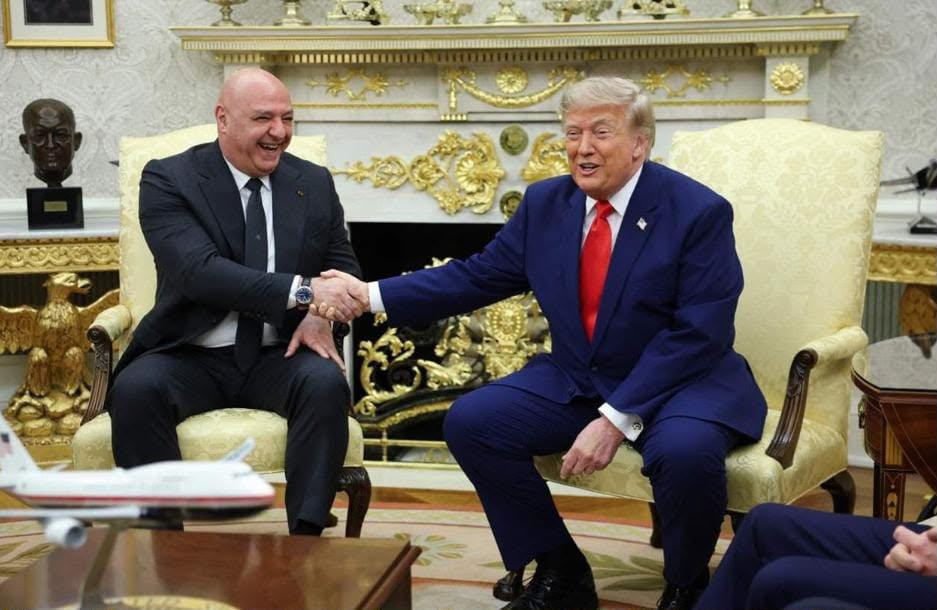
U.S. President Donald Trump received Lebanese President Joseph Aoun at the White House in a meeting that addressed the future of Lebanese-American relations, the security situation in Lebanon and the region, as well as Hezbollah’s weapons and the role of the Lebanese Army in the coming phase.
During the meeting, Trump affirmed that relations between Washington and Beirut are "good," describing President Aoun as "a very respected president," and stressing that the United States will work to help Lebanon. He said: "We will solve many of the problems in Lebanon, including Hezbollah."
Trump noted that Lebanon "was treated badly in the past," explaining that discussions would cover strengthening the Lebanese Army’s control over areas from which Hezbollah has withdrawn, in addition to developments related to the pilot phases of the safe zone project in Lebanon.
Regarding Parliament Speaker Nabih Berri’s position on the framework agreement, Trump said Berri is "a good person," adding: "When he sees the progress we have made, he will join us." He also said he was ready to communicate with Hezbollah if President Aoun requested it.
The U.S. president pointed out that the Lebanese president "has been confronting Hezbollah for a long time," considering that Syrian President Ahmad al-Sharaa could play an influential role in this file. He said al-Sharaa "is doing a great job in Syria," and that his intervention against Hezbollah could be practical, likening Aoun’s role in Lebanon to what al-Sharaa has done in Syria in terms of unifying the country.
For his part, President Joseph Aoun affirmed that Lebanon’s vision for achieving stability in the region aligns with President Trump’s vision, thanking him for what he described as the "historic achievement" linked to the signing of the framework agreement with Israel.
Aoun explained that the ultimate goal is to permanently end the state of hostility between Lebanon and Israel, stressing that Parliament Speaker Nabih Berri "wants an end to the war and supports the current path." He noted that the framework formula does not require the approval of the Lebanese Parliament, and that Berri is "a statesman who supports efforts aimed at ending the war."
Aoun stressed that the Lebanese Army constitutes "the backbone of security and stability," affirming his confidence in the military institution and its leadership. He said he had asked the U.S. president for political and military support for the army, because the collapse of this institution "is in no one’s interest."
On the regional front, Trump addressed the Red Sea file, affirming that the Bab el-Mandeb Strait has not been closed, and warning that measures would be taken if the Houthis attempted to shut down maritime traffic.
Trump also addressed the Iranian file, affirming that Tehran is strongly seeking to reach an agreement, but stressing his opposition to its possessing a nuclear weapon. He said pressure on Iran is continuing, arguing that the nuclear deal concluded during Barack Obama’s administration had, in his view, paved the way for Iran to reach that option.
Trump added that Iran needs many years to rebuild what has been destroyed, affirming that the United States "has not finished its work with Iran yet," and issuing a warning about targeting Iranian sites if the threats continue.
تابع آخر الأخبار أولاً بأول على قناتنا في واتساب
تابعنا