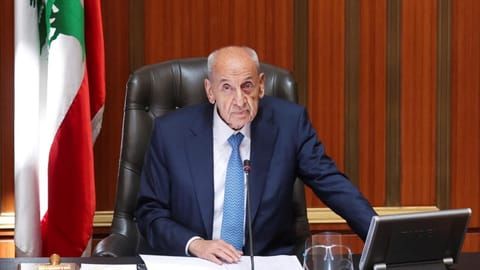
Speaker of Parliament Nabih Berri affirms that communication between him and President Joseph Aoun has not been interrupted, and believes that Hezbollah Secretary-General Sheikh Naim Qassem should not have said what he said when he hinted at bringing down the government in the street. “His remarks did not sit well with me, and we quickly contained the issue. The leaderships of the Amal Movement and the ‘Party’ held two meetings over the following two days to correct this position. In the Amal Movement, we do not speak this way; it is not our language, and I am certainly not with him on this.”
On the eve of the first meeting of the security-track team stemming from the fourth round of direct Lebanese-Israeli negotiations, due to be held today, Friday, President Nabih Berri remains unwavering in stressing his rejection of both direct negotiations and the security track, and does not hesitate to say he is not interested in either: “I do not know what will happen there and I do not want to know. The only thing that concerns me is the displaced and addressing their suffering.”
Berri adds: “I am against direct negotiations. I have been and will remain so, because we go into them without carrying anything with which to negotiate. Whoever sits at a negotiating table must possess cards to put forward in order to be able to extract a gain, and to sit with an enemy with at least a minimum degree of parity and balance. What are we going there with? Nothing—not even a single card.”
He also says: “That is the reason that always led me to call for indirect negotiations. I tried them twice with Israel. The first was in 2022 during the maritime demarcation talks. Dozens of times, the American mediator came to me and went to the Israeli side, conveying conditions and ideas until we reached maritime demarcation. In 2024, the same thing happened. For two and a half months, the American mediator would come to me and go to Israel, then return, until we reached a ceasefire.”
He adds: “In both instances, we did not sit with Israel at one table. Pakistan today offers the clearest proof of the importance of a mediator in resolving conflicts. It is not stronger than the Americans nor stronger than the Iranians, yet it has so far succeeded in mediating between them and managing their negotiations indirectly with their approval, and in conveying proposals, drafts and agreement frameworks. A mediator—any mediator—has an interest in making his mission succeed by extracting gains from both sides and imposing concessions on them. That is not what we are doing now; rather, we are going into direct negotiations empty-handed. What, then, do we expect?”
تابع آخر الأخبار أولاً بأول على قناتنا في واتساب
تابعنا