Lebanese President Joseph Aoun is seeking to avoid meeting Israeli Prime Minister Benjamin Netanyahu after U.S. President Donald Trump announced that he would soon invite both men to meet at the White House, amid reports that Washington is demanding Lebanon repeal the law criminalizing contact with Israel, on the grounds that the direct negotiations set to take place between the two countries require it.
Aoun’s effort to postpone or avoid a meeting with Netanyahu is based on the positions of some Lebanese political forces, as well as an Arab and regional stance inclined against such a meeting under the current circumstances, especially before an agreement is reached providing for Israel’s withdrawal from Lebanon and a halt to its military operations.
In this context, presidential adviser André Rahal visited Cairo two days ago and held meetings with Egyptian officials, where he also met Saudi Prince Yazid bin Farhan. The discussions focused on the need to preserve internal stability, prevent civil strife or any disruption to the course of the presidency and the government, and to try to persuade the Americans of the need to postpone the meeting with Netanyahu. More importantly, however, Lebanon must commit to restricting arms to the hands of the state and to implementing the decisions issued by Nawaf Salam’s government.
As the Lebanese await tomorrow, Thursday, the second meeting with Israel at ambassadorial level at the U.S. State Department in Washington, which will be devoted to discussing an extension of the ceasefire by 20 days or a month, Aoun is working to broaden the scope of his internal and external consultations in order to forge a unified Lebanese position backed by Arab and regional support before direct negotiations with Israel begin.
Amid reports that the U.S. ambassador to Beirut, Michel Issa, advised Aoun to expand the Lebanese negotiating delegation, which will be headed by Ambassador Simon Karam and is expected to include a military figure and a civilian technical figure so that it represents the various components, Aoun is studying widening consultations with different domestic forces, even if that requires calling for dialogue on the weapons file. Lebanon does not want to reach an understanding with Israel without internal consensus, nor does it want the picture to appear as though there is an Israeli-Lebanese agreement against Hezbollah. This, too, is understood at the regional and international levels.
4 demands, 5 conditions
At the same time, the headings proposed for the negotiations by Beirut and Tel Aviv remain far apart. According to the information, Lebanon is putting forward four clear conditions: first, an end to Israeli attacks and strikes, including assassinations; second, Israel’s withdrawal from all occupied territory and abandonment of the so-called Yellow Line; third, the release of Lebanese prisoners held by Israel; and fourth and finally, the full demarcation of the land and maritime borders.
The Israeli conditions, by contrast, are set at a very high bar. First, the Lebanese state must begin withdrawing Hezbollah’s weapons and dismantling its military structure. Second, an understanding must be reached with Lebanon on a mechanism for disarming and dismantling the party, ultimately preventing it from influencing Lebanese politics and state decision-making. Third, there will be no withdrawal before the objectives linked to Hezbollah’s disarmament are achieved, with any withdrawal to be gradual according to a timetable and stages synchronized with each step Lebanon takes in removing Hezbollah’s weapons from a specific geographic area. Fourth, Israel would retain a buffer or safe zone, and the issue of joint administration of this zone could be raised, but under Tel Aviv’s supervision and with the participation of its army. Fifth, a peace agreement or an agreement on security arrangements and economic understandings would be signed, whether regarding what the Israelis call the southern economic zone or an understanding related to oil and gas blocks, because Israel wants Lebanon to be tied to it in the oil and gas sector.
Diplomacy is not a sign of weakness
This came as French President Emmanuel Macron, during his meeting in Paris with Lebanese Prime Minister Nawaf Salam, reaffirmed France’s full commitment to the ceasefire in Lebanon and its support for the country’s sovereignty and territorial integrity, while diplomatic sources say Washington is seeking to sideline Paris, whose relations with Israel are tense. Salam had earlier stopped in Luxembourg to attend a meeting of European Union foreign ministers devoted to discussing the situation in the Middle East, where he said that choosing diplomacy is not a sign of weakness, noting that the scale of the challenges facing Lebanon requires greater international solidarity. Aoun likewise stressed yesterday, during a reception for a southern delegation, that “negotiations do not mean concession or surrender,” affirming that he “bears responsibility for his decisions, and that diplomacy is war without blood, whereas war is blood, destruction and ruin.”
Aoun stressed the preservation of rights and the importance of the Lebanese standing by their state at this particular moment.
Al-Budaiwi and restricting arms
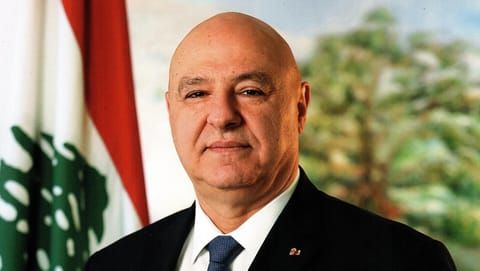
In a related context, Gulf Cooperation Council Secretary-General Jassim Al-Budaiwi said during a seminar organized by the council’s General Secretariat that GCC states will remain by Lebanon’s side, but at the same time “Lebanon’s future begins from within, from the will of its people and from their ability to build a strong, stable state.” Al-Budaiwi stressed that “Lebanon’s stability is directly linked to restricting arms exclusively to the Lebanese state and implementing international legitimacy resolutions, in a way that guarantees state sovereignty and prevents a slide into regional conflicts.” He also emphasized “the importance of strengthening cooperation with the international community and regional organizations to support the capabilities of the Lebanese army, control the borders, and combat smuggling and illicit activities, in a way that restores Lebanon’s standing as a reliable partner in its Arab and international surroundings.” He pointed out that Lebanon faces a major humanitarian and security challenge in light of the recent military escalation and the displacement of more than one million citizens, in addition to the economic crisis that has persisted for years, calling for concerted efforts to help it.