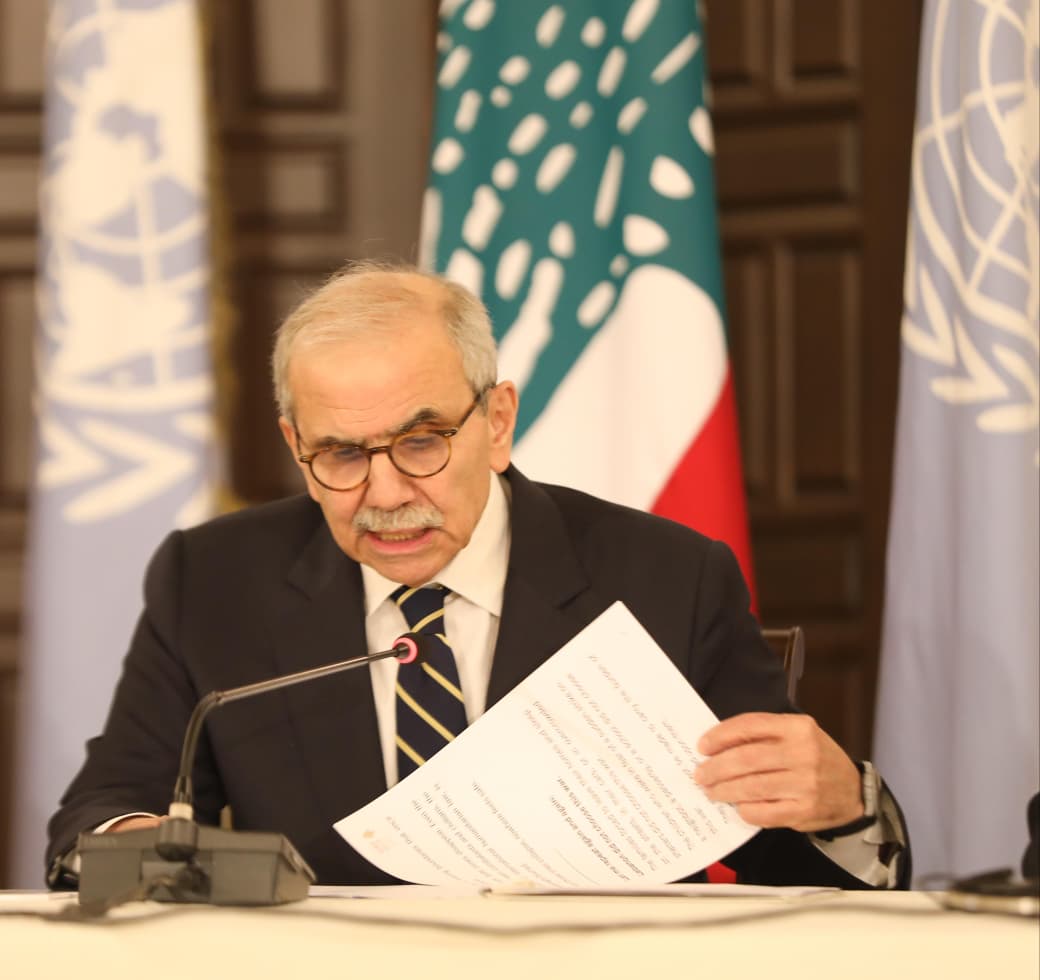
Mr. Secretary‑General
Distinguished Ambassadors and representatives of the international community,
Secretary General, thank you for standing with Lebanon today.
Your presence with us in Beirut sends a powerful message of solidarity at a moment when my country faces one of the most dangerous chapters in its modern history.
During your visit to Lebanon in January, you spoke of hope.
You said that “a window has opened paving the way for a new era of institutional stability”.
Today, that window risks closing.
As you noted only days ago, the Lebanese people are once again in the crosshairs; a conflict they did not choose, a conflict they do not want.
In recent weeks alone, more than 900,000 people – nearly one over 5 five residents - have been displaced across our country as hostilities intensified. In southern Lebanon, entire towns are emptying overnight.
Families are fleeing with little more than what they can carry.
Schools have become shelters. Hospitals are overwhelmed. Essential services are under immense strain.
Hundreds have been killed. Thousands have been injured.
Behind every number is a child, a parent, a family suddenly uprooted and traumatized.
Communities already weakened by years of crisis and conflicts are now stretched beyond their limits.
Modern warfare is erasing boundaries that once restrained conflicts.
Frontlines vanish. Safe zones disappear. Even the distinction between combatants and civilians, the cornerstone of international humanitarian law, is increasingly blurred.
When those lines collapse, nowhere feels safe
Let me repeat again and again:
Lebanon did not choose this war.
The families forced to leave their homes and sleep on the streets, in their cars, or in overcrowded shelters did not choose this war.
The children who wake in fear of a sudden strike on a neighbor, a passerby, or a school did not choose this war.
They should not be made to carry the burden of suffering inflicted upon them.
There is no justification in holding an entire nation hostage.
Lebanon’s people are not a battlefield.
Lebanon’s future is not collateral damage.
An immediate ceasefire is not a political option, it is a humanitarian necessity.
The fighting must stop.
Civilians must be protected.
International humanitarian law must be respected.
Your Excellencies
My government remains determined to restore authority of the Lebanese state across all our territory and hold the monopoly on weapons and took decisive steps to ensure that only the state holds the monopoly on weapons.
• The Lebanese army has already dismantled more than 500 military positions and weapons depots south of the Litani River, as part of a national plan to centralize weapons under state authority.
• We prohibited all military and security activities of Hezbollah and all non-state actors, Lebanese and foreign and required that weapons be handed over to the state, limiting political activity to constitutional and legal frameworks.
These actions are not symbolic gestures; they are concrete steps toward building a stable and unified security framework.
• At the same time, we strengthened border and security measures at Beirut’s international airport and along vital roads to protect our citizens and our international partners.
• Law enforcement agencies took firm action against those who attacked the forces of UNIFIL, demonstrating our commitment to protecting international partners who support Lebanon’s stability.
On the diplomacy front
I reaffirmed our readiness to resume negotiations with Israel under international auspices and with civilian participation.
Today, with this ongoing war, Lebanon stands at the edge of a humanitarian abyss.
Without rapid mobilization of international support, the humanitarian consequences will deepen dramatically in the days and weeks ahead.
I am therefore calling on the international community to stand with Lebanon; not only with words of solidarity, important though they are, but with decisive political and humanitarian action.
Yes, we do urgently need coordinated humanitarian assistance, medical supplies, food, shelter, and fuel to sustain critical infrastructure.
But, we also need sustained diplomatic engagement to halt the escalation
And help to restore stability in Lebanon and to revive the hope of just and lasting peace in our region.
Mr. Secretary General,
Ladies and Gentlemen,
For Lebanon, this is a moment of survival. For the international community, it is a moment of responsibility.
And let us remember that history will judge us not by the words we speak, but by the hope we seed.
Thank you again for being with Lebanon today.