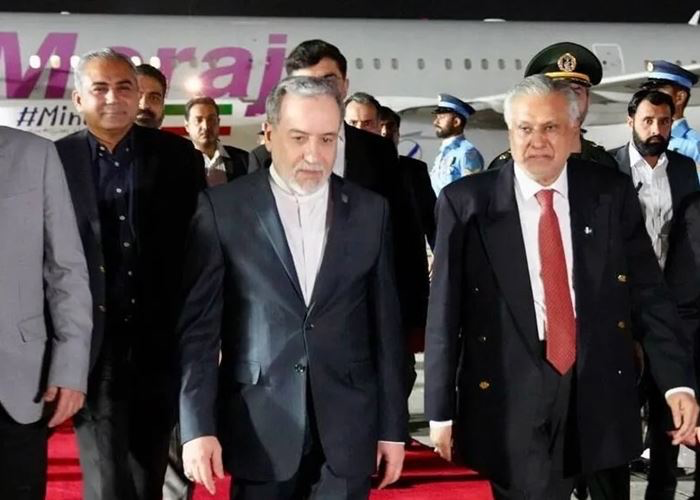
Pakistani officials said on Sunday that Pakistan’s political and military leadership is racing against time to revive ceasefire talks between the United States and Iran, after U.S. President Donald Trump told his envoys not to travel to Islamabad for negotiations at the start of this week.
The Associated Press quoted two Pakistani officials as saying that Iranian Foreign Minister Abbas Araghchi had arrived in Islamabad after a visit to the Sultanate of Oman, while the two officials did not specify when the U.S. side would return to the region.
The official involved in the mediation efforts said Iran is still insisting on ending the U.S. blockade on its ports before a new round of talks begins, and that mediators led by Pakistan are trying to bridge the wide gap between the two countries.
For its part, Iran’s Tasnim news agency quoted informed sources as saying that Araghchi’s return to Islamabad is not linked to the nuclear negotiations, but rather comes as part of his regional tour following his previous visit to Islamabad and the Sultanate of Oman, to continue consultations with Pakistani officials.
The sources indicated that the agenda of Araghchi’s visit would include, alongside bilateral relations, conveying Iran’s conditions for ending the war to Pakistan in its capacity as a mediating state. These conditions include imposing a new legal framework on the Strait of Hormuz, obtaining compensation, guarantees against a repeat of what Tehran describes as military aggression, and lifting the naval blockade.
Araghchi had headed to the Sultanate of Oman, which had previously played the role of mediator between the two countries, and a Pakistani official explained that Araghchi’s talks in Oman focused on issues related to the Strait of Hormuz.
Iranian state media reported that Iranian Foreign Minister Abbas Araghchi left the Pakistani capital on Saturday evening and returned to Islamabad on Sunday before heading to the Russian capital, Moscow.
Earlier, Iran’s Foreign Ministry said Araghchi discussed with Oman’s Sultan Haitham bin Tariq Al Said ways to end the war and developments in regional security, in addition to ensuring freedom of navigation in the Strait of Hormuz.
The Iranian Foreign Ministry added that the two sides discussed developments in the ongoing talks within the framework of mediation efforts led by Pakistan, amid the stalled negotiating track between Tehran and Washington.
Araghchi stressed the need for regional countries to work on building collective security mechanisms, away from what he described as “American interference,” considering that “the war on Iran has shown that the U.S. military presence in the region leads to insecurity and deepens division.”
The Iranian minister expressed his country’s appreciation for the Sultanate of Oman’s positions in supporting dialogue efforts and strengthening endeavors for security and stability in the region, especially in light of the current challenges.