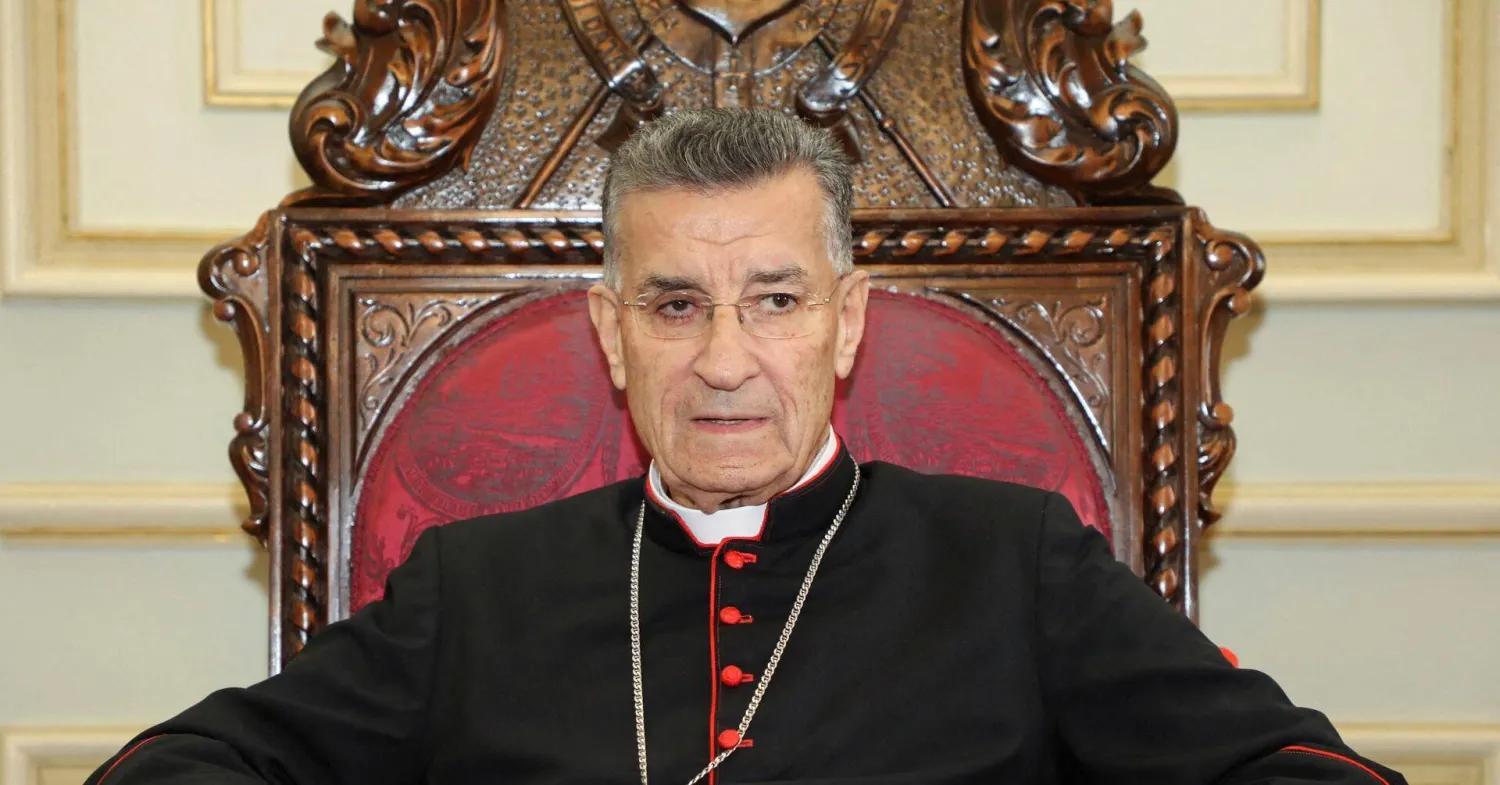
Maronite Patriarch Cardinal Mar Bechara Boutros Al-Rahi presided over Sunday Mass on the occasion of the 60th World Day of Social Communications, delivering a homily on the meaning of love in the Gospel and its role in building the human person, society, and the nation, in addition to the mission of the media in a time of digital transformation.
After the Holy Gospel, Al-Rahi opened his homily under the title:
“Yes, love one another as I have loved you” (John 13:34), saying:
“How great these words are, and at the same time how simple. It is a small Gospel in size, yet an endless sea in its meanings. It is the Gospel of love, the new commandment that Jesus left to his disciples before his Passion, as though he were entrusting them with the summary of the entire Gospel and the whole of Christian life. In those final moments, Jesus did not command them to seek authority, nor power, nor earthly greatness, but rather love: love that forgives, love that endures, love that always gives itself for the sake of the other. Christ did not love in words, but in deeds. He loved humanity to the end, to the Cross, and to total self-giving. This is today’s Gospel: the Gospel of love that does not fail, love that builds, love that changes the human person and the world. For a person may live by power for a time, and by interest for a time, but cannot truly live except by love. That is why the Lord said: ‘By this everyone will know that you are my disciples, if you have love for one another’ (John 13:35).”
He added: “I am pleased to welcome you all, with a special greeting to His Excellency the Minister of Information, and to the male and female media professionals at this celebration in which we mark the 60th World Day of Social Communications. We offer this holy sacrifice for your intention and for the success of the mission of the communications media, and we pray with His Holiness Pope Leo XIV and the Church that the media may remain a space of encounter and truth, and a service to the human person, not a tool of division or disinformation. At the beginning of this liturgy, we listened to the words of our brother Bishop Mounir Khairallah, shepherd of the Diocese of Batroun and president of the Episcopal Commission for Media, whom we thank, on the content of His Holiness the Pope’s message for this day, entitled: ‘Preserving Human Voices and Faces.’ We also welcome the esteemed Hneine Family Association, headed by Mr. Nadim Hneine, and we wish them continued unity and cooperation in their lives and projects.”
He continued: “‘Love one another as I have loved you’ (John 13:34). This is the new commandment. What is new in it is not only the word ‘love,’ for humanity has known love since ancient times, but the true newness is this measure that Jesus set: ‘as I have loved you.’ This is what is new. How did Christ love us? He loved us without conditions. He loved us despite our weakness and our sins. He loved us to the point of giving himself for us.
He loved us in order to raise us up and save us. Therefore, love in Christianity is not merely an emotion, nor simply beautiful words, but a way of life.
Love means accepting the other, forgiving him, carrying him in my prayer, supporting him, seeing him as a human being with dignity and worth. Christ did not ask his disciples to outdo one another, but to love one another. For love alone builds the community, builds the Church, and builds the human person from within. Love transforms the human person, heals wounds, restores trust, extinguishes hatred, and creates peace. That is why the commandment of the Lord Jesus remains new in every age, because no matter how much the world advances, it remains in need of love.
Without love, the human person becomes a hardened heart; without love, society becomes an arena of conflict; and without love, the nation becomes a place of fear and division. For a person to love in a time of divisions and hatred requires a great heart and great faith.”
He went on: “Lebanon today needs love more than ever. Love of الوطن in the hearts of citizens is what builds the nation and embraces it, and makes its sons and daughters united, working for it and in its service. Lebanon is not built by corruption, nor by hatred, nor by selfishness, but by love, transparency, ethics, and honesty. Yet we say that today we are living in difficult circumstances, amid ongoing attacks and violations, and in a reality that is growing ever more ambiguous. Enough hatred—let us love. Through love we meet, through love we reconcile, through love we forgive, and through love we build a nation in which the human person feels security, dignity, and belonging. We are children of love, not children of hatred.
We are children of life, not children of war. That is why we hold fast to the culture of peace, saying: no peace without love, no to war, yes to peace. Peace alone preserves the human person and the nation. There is no peace without love, no nation without love among its people, and no future can be built if hearts remain submerged in fear, division, and tension.”
He added: “Nations are not preserved by weapons, nor protected by force, but by a people who know how to love, how to meet one another, and how to place the common good above narrow interests. Nations are preserved by a living conscience, protected by sincere hearts, and built by love that enables a person to see in his brother a partner, not an adversary, a brother, not an enemy. Today’s Gospel calls us to love one another as Christ loved us. These words are not only for personal relationships, but also for national life. To the extent that we are able to love, meet, forgive, and place the interest of the nation above every other consideration, to that extent we are able to build a true homeland in which the human person lives in peace, reassurance, and dignity. Nations do not live by fear, but by trust. They do not live by division, but by encounter. They do not live by hatred, but by love. Therefore, amid all that we are experiencing of anxiety, waiting, and ambiguity, our faith remains firm that love alone is capable of saving the human person, rebuilding the nation, and opening the door to peace. Love alone endures, and by love we live. With love we entrust this nation to God, asking Him to protect it from evil and division.”
Al-Rahi concluded: “Let us pray, dear brothers and sisters: Lord, you who gave us your new commandment, plant your love in our hearts, and remove from them all hatred, fear, and division. Teach us to love as you loved us, to forgive, to meet one another, and to build peace. Bless our nation Lebanon, grant it the grace of reassurance and stability, and keep wars, divisions, and evils far from it. Make us witnesses to your love in this world, so that all may know that we are yours, because we have love for one another. And so we raise glory and thanksgiving to the Father, and the Son, and the Holy Spirit, now and forever. Amen.”
تابع آخر الأخبار أولاً بأول على قناتنا في واتساب
تابعنا