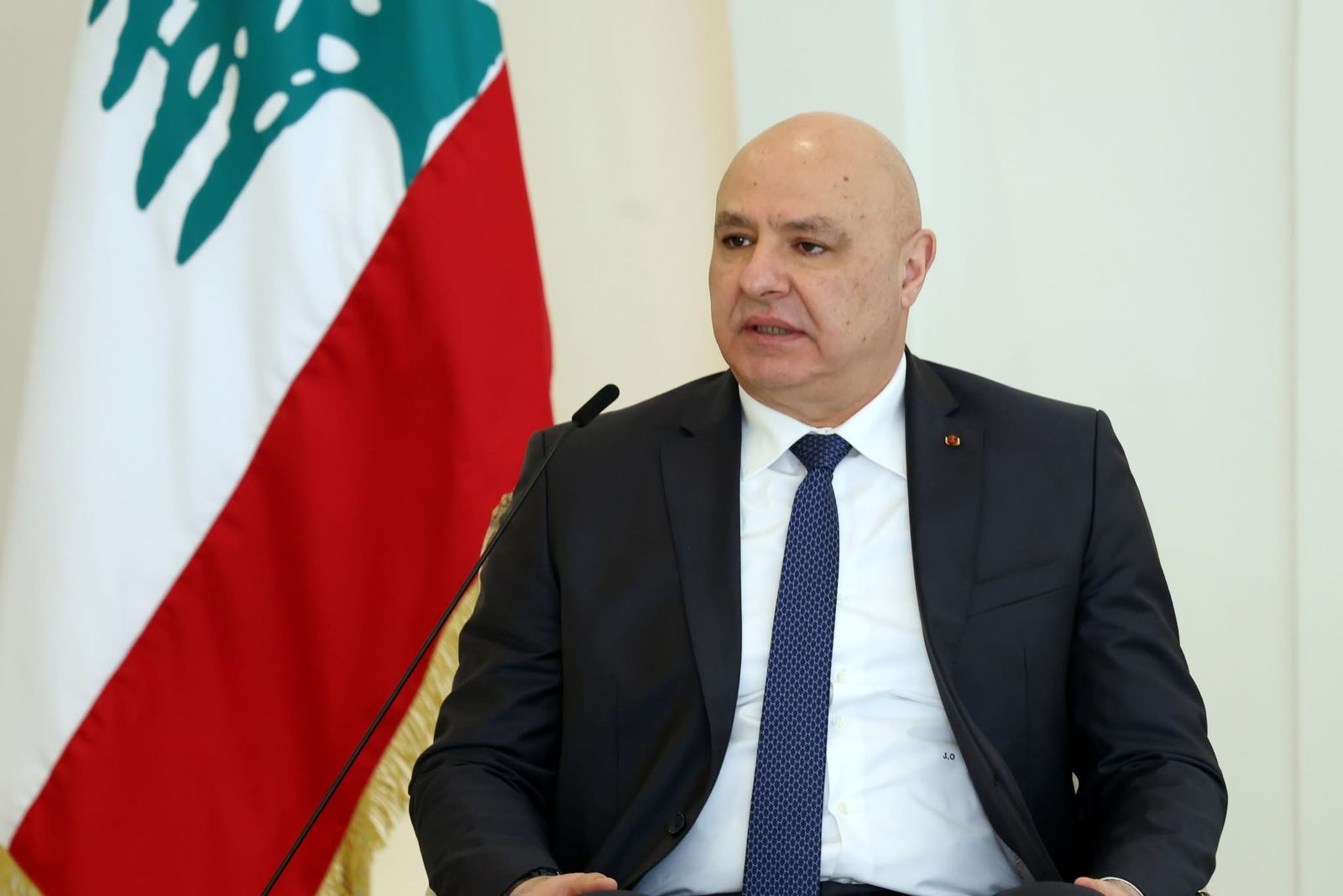
President Michel Aoun affirmed that the Lebanese Army is a national institution that serves the interests of Lebanon and its people, not those of any party or sect, but the interests of the nation. He stressed that the recent unjustified campaigns against the army and its commander will have no impact on the performance of the military, assuring those behind these campaigns that “their basket will be empty.”
The president made these remarks during a visit this morning to the Ministry of Defense and the Army Command in Yarzeh, beginning with a meeting with Minister of National Defense Major General Michel Mansi in his office, where they discussed the overall situation in the country and current security developments.
President Aoun and Minister Mansi then proceeded to the Army Command, where they were received by Army Commander General Rudolf Heikal, in the presence of Chief of Staff Major General Hassan Aouad, Director of Intelligence Brigadier General Antoine Kahwaji, and Chief of Staff of the Commander Brigadier General Mansour Zgheib. The president was briefed on the security situation across Lebanon and the conditions of troops deployed in the south, as well as the personal circumstances of soldiers who were forced to leave their homes due to Israeli attacks and relocated to other areas.
Following this, President Aoun chaired a meeting attended by Minister Mansi, General Heikal, members of the Military Council, deputy chiefs of staff, intelligence and operations directors, and several senior officers.
President Aoun opened the meeting by greeting the army, emphasizing that it is a unifying national institution that enjoys the trust of the Lebanese people and recognizing the sacrifices of soldiers in all circumstances. He stressed that his visit expresses full solidarity with the army and its leadership, and rejects any campaigns targeting them or questioning their patriotism. The army is not a party to political disputes, and he warned against turning it into a tool for internal disputes, as the strength of the state begins with the strength of its institutions, foremost among them the army.
He criticized the unjustified accusations against the army, calling them the work of irresponsible people lacking national conscience, asking, “What have you provided to the army morally and materially? You even target their meager salaries and attempt to reduce them?” He urged those who hastily accuse the army to visit the south, the capital, the mountains, and other areas to witness the conditions under which officers and soldiers serve their country and people. The army uniform itself is a symbol of honor and patriotism. He affirmed that accusations have no value as the soldiers are deeply rooted in patriotism, and whatever efforts are made against them, there is a strong shield protecting the institution.
President Aoun told the attendees: “Do not be affected; let your achievements speak for you. What is happening is a passing cloud. No matter what is said about the army, the people stand with you and appreciate your efforts. The work you do under these conditions exceeds natural expectations. Continue your duties with conscience and courage; you are greater than all rumors, and your loyalty to Lebanon contrasts with those who prioritize personal interests. What happened in 1975 shows that the army was the first institution targeted, and today, if that is the aim, it will not succeed, and ‘their basket will be empty.’”
He emphasized the importance of caring for the army and its members to preserve the country, assuring that the people will hold accountable those who attack the military. He urged soldiers to remain united and steadfast, warning that if the army falters, the whole country is at risk. He pledged to defend the army against any internal threats, stressing that attempts to replace the commander target the institution, not the individual.
President Aoun affirmed that the army operates according to the Constitution, laws, and decisions of political authorities, and that Cabinet decisions are implemented within constitutional mechanisms and available resources. He reassured the military that the political leadership stands by them, as the Lebanese people trust the army as the guarantor of national unity and stability.
At the conclusion of the meeting, Minister Mansi thanked President Aoun for his visit, affirming the army’s unity and solidarity and stating that it will act only in Lebanon’s interest and remain a protective barrier against any internal strife. Army Commander General Heikal also thanked the president, emphasizing that the army remains loyal to Lebanon and its principles.
Earlier at Baabda Palace, President Aoun held a series of ministerial and parliamentary meetings to review conditions in various Lebanese regions. He met with Minister of Economy and Trade Amr Bassat to discuss economic conditions, local market needs for food and fuel, and ministry efforts to ensure the availability of essential goods. Minister Bassat stated that food security is assured, stockpiles of wheat, flour, and fuel are high, imports continue uninterrupted, and the government is monitoring prices to prevent exploitation amid global price increases.
President Aoun also met with Minister of State for Administrative Development Fadi Maki to review ministry operations, including anti-corruption measures and support for whistleblowers. Minister Maki stressed the importance of supporting refugees as part of national unity and backing the Lebanese state and army in these critical times.
President Aoun met with MPs Wajih Ba’arini and Ahmed Rustum to discuss current developments and regional impacts on Lebanon. Ba’arini confirmed support for the president’s initiatives and the national army, emphasizing the army’s role as the guarantor of security and stability.
President Aoun also met MP Haidar Nasser, who expressed support for national choices and the Lebanese state, and briefed the president on the refugee situation in the Tripoli area in detail.