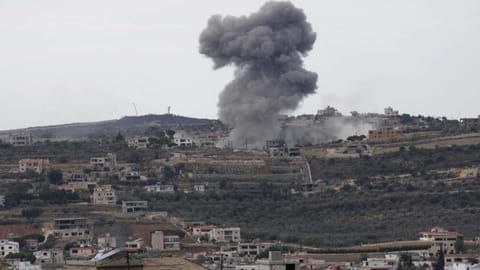
The Israeli army has stepped up the pace of demolitions and destruction in villages in southern Lebanon, hours before the first direct session between the Lebanese and Israeli ambassadors in Washington, in preparation for exploiting any field opportunity to achieve objectives the Israeli army had previously announced, ahead of any possibility of reaching a ceasefire.
Clashes continued in Bint Jbeil, where the Israeli army said that during operations by paratroopers brigade forces overnight in Bint Jbeil, the troops engaged face-to-face with a cell of three fighters who opened fire on them. It said that “in a rapid closure of the circle, the forces, with air support, succeeded in eliminating two militants and targeting the building in which they had barricaded themselves,” while a third was pursued. Three Israeli soldiers were seriously wounded, one soldier moderately wounded, and six others lightly wounded.
Military operations escalated at a heavy pace, as explosions in the villages coincided with strikes and air raids on villages surrounding the areas of incursion, which serve as fire-support platforms for Hezbollah fighters in Bint Jbeil, the Khiam front, Taybeh and elsewhere. In this context, Israeli media circulated a video it said documented the moment a drone swooped down on a Hezbollah member and killed him in southern Lebanon, while Hezbollah, for its part, published a video report titled “Zero-distance clashes in Bint Jbeil, and targeting enemy gatherings,” underscoring the intensifying media war accompanying the battlefield confrontation.
Field messages
On the ground, the escalation was not limited to shelling, but was accompanied by clear signs of entrenching facts on the ground. The Israeli army published a photo of the commander of the Givati Brigade from inside Bint Jbeil, standing before a wall bearing pictures of Hezbollah dead, in a move carrying dimensions that go beyond military documentation to symbolic messaging.
This coincided with Israeli reports saying forces had deployed inside southern Lebanon to a depth of between 7 and 10 kilometers from the border, reflecting an attempt to establish an advanced field security zone, or at least impose a new deployment equation on the eve of negotiations.
By contrast, the axes of Bint Jbeil, Haris and their surroundings witnessed heavy artillery shelling, alongside intermittent clashes in the city of Bint Jbeil, indicating that the incursion remains governed by direct confrontation that prevents the consolidation of full control, reinforced by Hezbollah’s account of close-range clashes along these axes.
From the border edge to the interior
The scope of airstrikes expanded to include a wide range of southern towns, from Zawtar al-Sharqiya, Jouaiya and Qabrikha, to Kfardounine, Qleileh and Shamaa, reaching the outskirts of Shebaa, Braasheet and Siddiqine. Drones also targeted internal roads, including the road to Mahruna and the al-Assi area between Siddiqine and Kafra, resulting in deaths and injuries.
The shelling extended toward the Jezzine area, where a house in the town of Rihan was targeted, while another strike hit a car on the Abbassiyeh-Tyre road, indicating an increasing focus on moving targets.
Psychological warfare was also present, with leaflets dropped over the town of Shebaa in an attempt to influence residents in the border areas.
Targeting civilian infrastructure
The nature of the targets shows that the strikes are no longer confined to military sites, but have directly hit civilian infrastructure. The towns of Ain Baal, Aytit, al-Majadel, Arnoun, al-Housh and Qallouiyeh were targeted.
In al-Housh-Tyre, shelling of residential buildings caused widespread destruction to homes and infrastructure, including electricity networks and shops. The targeting of a house in Arabsalim also left two people dead and a woman injured, with the building completely destroyed.
The shelling also extended to public facilities, most notably the old municipal building in Adloun, while another raid struck a house in Deir Antar, where rescue teams continue search operations amid the rubble.
At dawn, the town of Tebnine was hit by a violent strike that caused severe damage to the government hospital, heightening concern over the targeting of vital facilities. A strike on a car on the Masilh road also set it ablaze and killed two people.
In Bafliyeh, a raid caused widespread destruction, while civil defense teams continue searching for missing persons, and the targeting of a house in al-Shabriha left one person dead and three wounded.
The shelling extended across a wider geographic area that included Jabal al-Butm, Mansouri, Shaabiyeh, Bissariyeh, Arabsalim, Ansariyeh, Mahmoudiyeh and the surroundings of Nabatieh al-Fawqa, while illumination flares were fired over Tyre and its coastline.
The Bekaa enters the equation
In a significant development, the escalation was no longer confined to the south. A dawn raid targeted the town of Sahmar in the western Bekaa, killing three members of the same family and injuring a fourth, in addition to causing major destruction, in a sign of the widening scope of operations.
In this context, Hezbollah announced that its fighters “confronted, on Monday, an Israeli warplane in the skies over the western Bekaa with a surface-to-air missile,” in a step reflecting an attempt to introduce the element of direct aerial engagement into the battle.