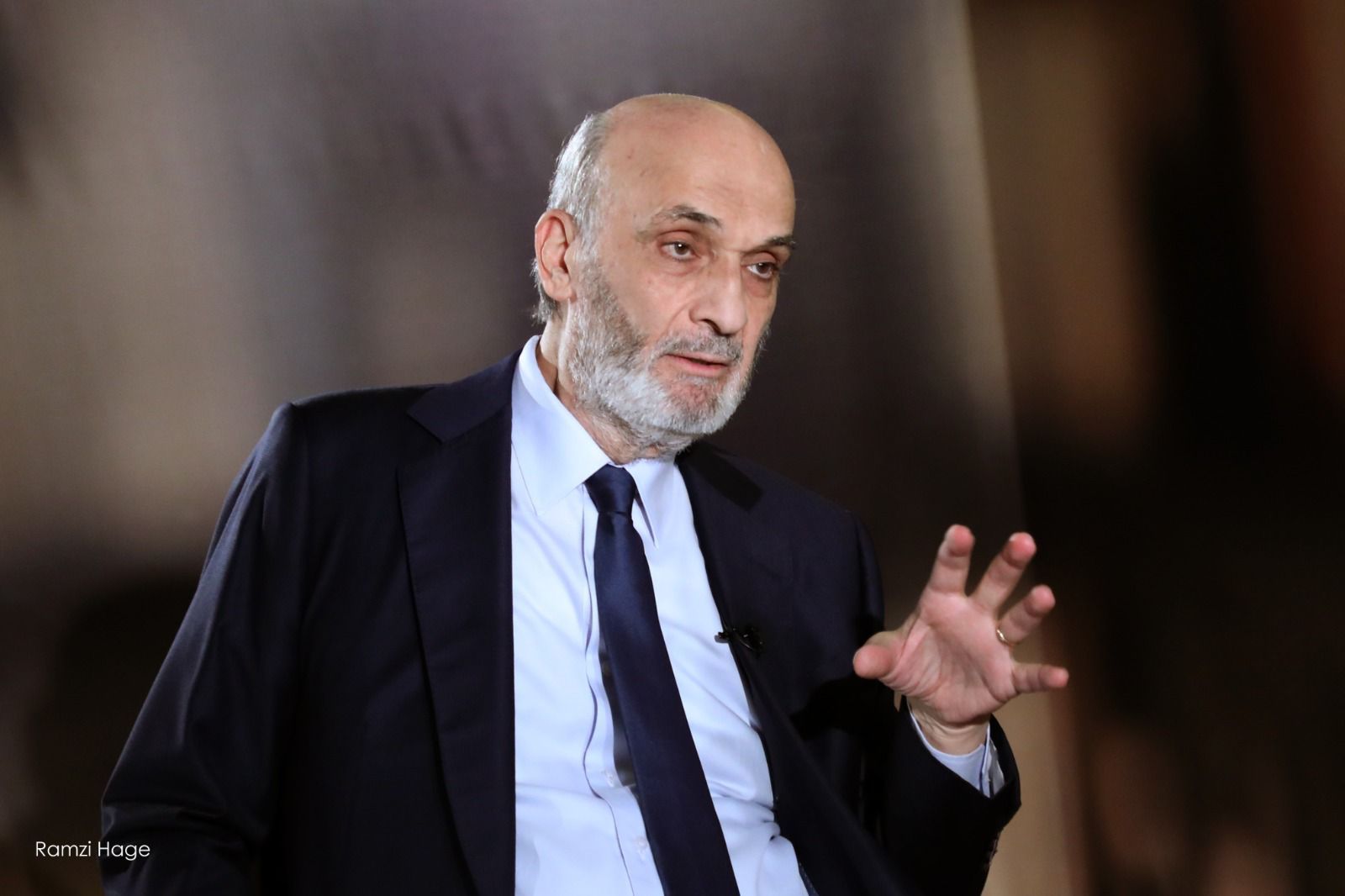
In an interview with Sky News with journalist Hadley Gamble, the head of the Lebanese Forces Party, Samir Geagea, painted a grim picture of the Lebanese reality, considering that the crisis is primarily internal rather than external, due to the continued existence of Hezbollah as a “state within a state” alongside the official government, controlling national decisions for four decades, while the official state remains incapable of enforcing its decisions.
Geagea said that Lebanon currently operates on two parallel levels: a state that negotiates and tries to manage the crisis, and a “state within a state” that makes the actual decisions. He added that the Lebanese government has issued many decisions and decrees regarding Hezbollah, but the problem is not in making decisions but in the inability to implement them. He pointed out that the president and government may act positively in any external dialogue, but the problem begins when returning to internal Lebanese affairs, where the state does not possess full authority.
Geagea emphasized that the problem is not with the United States, Israel, Gulf countries, or Europe, but primarily with the Lebanese themselves, because Lebanon, according to him, has not been able for forty years to build a real and normal state due to the existence of a parallel “state within a state.”
He rejected linking the resolution of the Hezbollah issue to yielding to external pressures, stressing that resolving Hezbollah’s position is first and foremost in the interest of the Lebanese, because the absence of a normal state is what has led the country to this collapse, even though the Lebanese themselves have not changed—they have not become less intelligent or capable, but rather more cultured, in his words.
Regarding the state’s inability to implement decisions, Geagea said that the current government may be the best government Lebanese citizens have seen in recent decades, and that people trust the direction of its decisions and decrees, but they do not see actual and effective implementation—only very limited and partial steps. He added that the problem lies in the absence of an executive apparatus capable of translating political decisions into action, considering that “the state is on one side, and the rest of the administration is on another.”
In this context, Geagea spoke of what he called the “deep state” in Lebanon, saying it includes various security agencies, from the army to internal security forces, in addition to parts of the judiciary. He considered that many within these institutions remain captives of what he called the “Stockholm syndrome” in their approach to Hezbollah. He clarified that he is not specifically talking about the army commander alone, but about a whole system that does not function as it should, evidenced by the fact that the government “did what it had to do,” yet the country remains at the same point.
Geagea noted that Hezbollah has undoubtedly been weakened, but this has not yet reflected in decisive executive decisions, citing the continued presence of the Iranian ambassador in Lebanon despite a clear decision on the matter. He argued that the problem is not with the president, prime minister, or foreign minister, but with the administration, which does not follow the political authority as it should.
Regarding ongoing or upcoming negotiations, Geagea emphasized that negotiations with Israel were not a pre-planned Lebanese choice but “necessity negotiations” imposed by the situation Hezbollah created for the Lebanese state. He said the president and prime minister are not taking this step out of theoretical conviction or pre-existing choice but out of necessity to get Lebanon out of the “garbage” and “mud” it found itself in. He added that anyone with an alternative path to save the country should present it clearly, because the Lebanese “are tired of empty words and poetry.”
About the future of Lebanon-Israel relations, Geagea said he does not know whether it is possible to reach a normal situation similar to what happened between Israel and other Arab countries, but stressed that the immediate need is not a ceasefire or temporary truce, but ending the state of war itself. He reminded that Lebanon was historically not one of the “confrontation states” according to the Arab League classifications in the 1960s but a support state, because its economic capabilities do not allow it to engage in an open military confrontation with Israel. He explained that such a confrontation would require a large army and an annual cost of no less than $20 billion for ten to twenty years, whereas Lebanon’s current GDP does not exceed $25 billion. Therefore, he believed Lebanon should continue supporting the Palestinian cause but without being dragged into war again, as it would be destructive.
Regarding fears of internal explosions, Geagea said he does not see a likelihood of sectarian violence between Christians and Muslims, except if state administration completely collapses as it did in 1975. He clarified that as long as the state exists, even if not strong enough, he does not fear internal strife.
On Lebanon’s leverage in negotiations, Geagea considered that Lebanon’s main leverage lies in Lebanon itself, describing it as “the jewel of the region,” and noting that many, especially in the region, still love Lebanon for what it represents. He added that despite all the collapses, Lebanon remains a genuinely democratic country, citing recent elections as real elections. He noted that even at the height of Hezbollah’s power, it only had very limited influence on them. He argued that one of the main issues Lebanon should bring to any discussion table is the restoration of a normal state and securing the borders, whether with Israel or Syria, considering that Lebanon’s primary problem over past decades was its inability to control its borders. He rejected the continued presence of armed Hezbollah on the Syrian border, which allows occasional provocations of the Syrian regime.
In response to Israel’s repeated statements about retaining the freedom to act militarily in southern Lebanon if it feels threatened, Geagea rejected this logic, recalling the period between the 1949 armistice and the start of Palestinian guerrilla operations in 1964, when southern Lebanon enjoyed relative calm, with incidents limited to small Palestinian camps and their collaborators, not the local population. He said history shows that if Lebanon controlled its borders properly, there would be no logical reason for Israel to seek additional Lebanese land. He considered that any serious negotiations, especially if led by President Joseph Aoun, would clarify the picture more effectively.
Geagea also rejected the proposal to postpone any direct meeting between the Lebanese president and Israeli prime minister until after agreements are reached, considering that postponing meetings would only keep Lebanon stuck in the current situation for decades. He noted that the current conditions differ from the 1980s when regional equations were completely different, with Hafez Assad and Khomeini at the height of their influence.
Regarding the U.S. role, Geagea considered the United States an acceptable mediator, without guaranteeing full fairness between Israel and any other party. He emphasized that the Lebanese cannot afford to reject the attempt, as the alternative is indefinite continuation of the crisis.
Regarding the U.S.-Iran confrontation, he believed that a U.S. victory would make removing Hezbollah from Lebanon much easier. He added that he does not believe the U.S. can lose to Iran and that the current events, including the Strait closure, are still part of a larger picture whose outcome is not yet clear.
Concerning the Lebanese army, Geagea refrained from a detailed discussion about the military leadership, describing it as a sensitive and decisive internal debate that should remain within official Lebanese frameworks, whether with the president or army commander. However, he reiterated that the “deep state” as a whole is not in good shape, evidenced by the government taking necessary decisions without accompanying effective implementation.
He warned that stopping U.S. funding for the Lebanese army would pose a very serious challenge, though not necessarily catastrophic. He considered that the Lebanese government should not let things reach this stage and should act to correct the situation beforehand. He linked this risk to the enormous economic cost of the crisis, noting that Lebanon was close to emerging from its last crisis before finding itself again at the heart of collapse, with direct and indirect losses approaching $10 billion due to the war so far. He stressed that Lebanon cannot bear any additional war, which is why he supports the president negotiating to find an exit from “this hell.”
Regarding what the Lebanese president should demand, Geagea said that any external demand loses its value if the internal problem is not resolved first, because the president will not be able to extract anything unless the state becomes the actual decision-maker. He added that the main demand should be the withdrawal of Israeli forces and a return to internationally recognized borders, in parallel with deploying a real Lebanese army that truly controls the southern and eastern borders.
Concerning the role of Gulf countries, Geagea emphasized that they have always supported Lebanon. He went as far as saying that without Saudi Arabia, the recent 2024 presidential elections would not have been possible, affirming that he knows this “with certainty.” He explained that Gulf countries have relatively pulled back because they did not see actual changes on the ground and that they will rush to help Lebanon again as soon as they see government decisions being made and effectively implemented. He added that Gulf countries, beyond politics and geopolitics, truly love Lebanon, with many of their nationals still owning homes and palaces there and having personal friends and connections.
Regarding broader international support, particularly U.S. support amid ongoing developments in Syria, Geagea said Lebanese should expect this support as soon as possible, but only after Lebanon fulfills its internal duties. He reminded that the U.S., Europe, France, and Gulf countries have rushed to help Lebanon on many occasions and are ready to do so now as well, but the basic condition is that Lebanon is present as a real state and decision-maker, not as a country where money is pumped in only to be redirected elsewhere.
At the end of the interview, when asked whether he intends to run for the presidency in the future, Geagea replied that it is far too early to discuss such a matter, noting that the president was elected last year and that the next elections are still five years away. He then added: “Let’s first fix the situation in Lebanon. But who knows?”