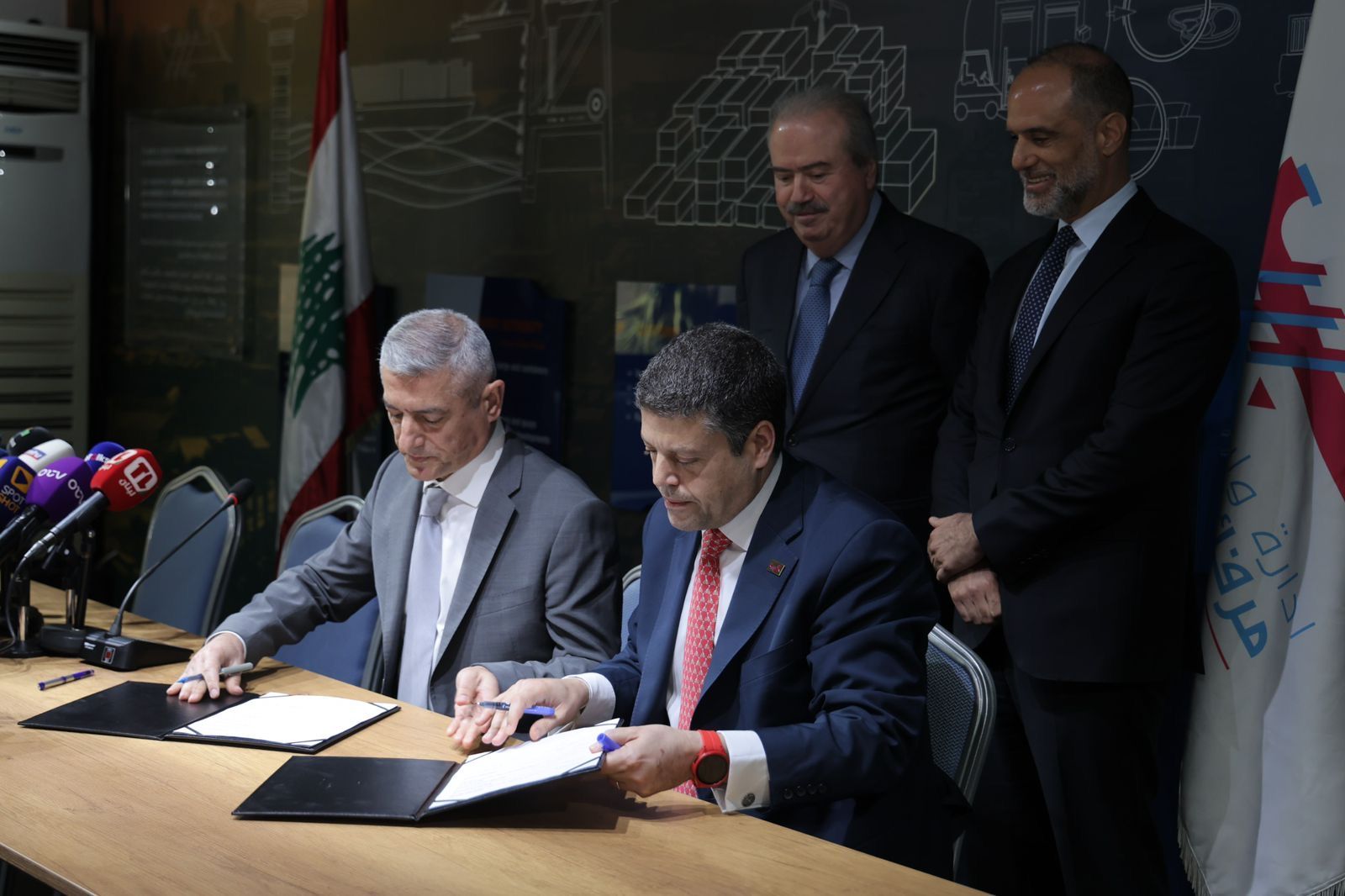
Under the patronage and in the presence of the Ministers of Finance and Public Works and Transport, Yassine Jaber and Fayez Rassamni, the Beirut Port Authority and Investment, represented by its Chairman and Director-General Marwan Naffi, and the Higher Customs Council, represented by its President Brig. Gen. Misbah Khalil, signed a memorandum of understanding on the operation of scanners.
Before the signing ceremony, those present toured the scanner site, where they were briefed on the operating mechanism, the procedures in place, and the role these systems play in speeding up inspection operations and strengthening oversight.
Jaber:
Finance Minister Yassine Jaber said in remarks: "Allow me first to explain why we are here today. We met some time ago in this hall when we were at the stage of reviewing the arrival of the scanners. Today, we are formally establishing the relationship between Customs and the port authority, so that the use of these devices is officially adopted after training has been completed and all the necessary preparations finalized to enable Customs to use them.
I would like to thank the Minister of Public Works and the Beirut Port administration for their efforts and this initiative, and I also thank CMA CGM, which brought in the scanners and is overseeing their operation and maintenance. This is a very important step, and it is part of a long process until the customs work we intend to achieve is fully completed."
Jaber added: "There are still a number of software programs to be installed, in addition to an artificial intelligence program for image analysis, a system for advance declarations of imported goods, a risk assessment program, as well as a new information system for customs management that will be fully activated, with data transferred from the old system to the new one.
This step today is essential and foundational in the process of developing customs work toward a better future and greater effort, in a way that boosts state revenues, speeds up procedures for releasing containers and goods, and makes life easier for importers, all in support of the Lebanese economy."
He concluded: "I reiterate my thanks to the Customs Administration, the Higher Council, and all customs personnel for their efforts to improve operations. I also renew my thanks to my colleague Minister Rassamni, as we work together on many useful initiatives for the benefit of the country."
Rassamni:
For his part, Minister of Public Works and Transport Fayez Rassamni stressed that the scanner file constitutes a fundamental pillar in the process of reforming the Port of Beirut and enhancing its performance, affirming that this project was not merely technical, but a strategic choice combining security and financial dimensions. He said: "Operating the scanners is an important achievement in terms of revenue collection, in addition to its essential role in protecting the country from the entry of dangerous materials."
He added: "Training new employees requires time, but they will work with a high national spirit, while the port’s security and safety remain a non-negotiable priority." He confirmed that work is proceeding in parallel to address the structural gaps that contributed to the port explosion, stressing that "everything related to this catastrophe will be addressed in a way that ensures it is not repeated."
Rassamni explained that the introduction of scanners comes within an integrated approach aimed at controlling operations inside the port, enhancing transparency, and raising the level of oversight, which will directly improve the state’s public revenues. He noted that this path, despite its complexity, represents a real starting point toward rebuilding a modern port administration capable of keeping pace with international standards.