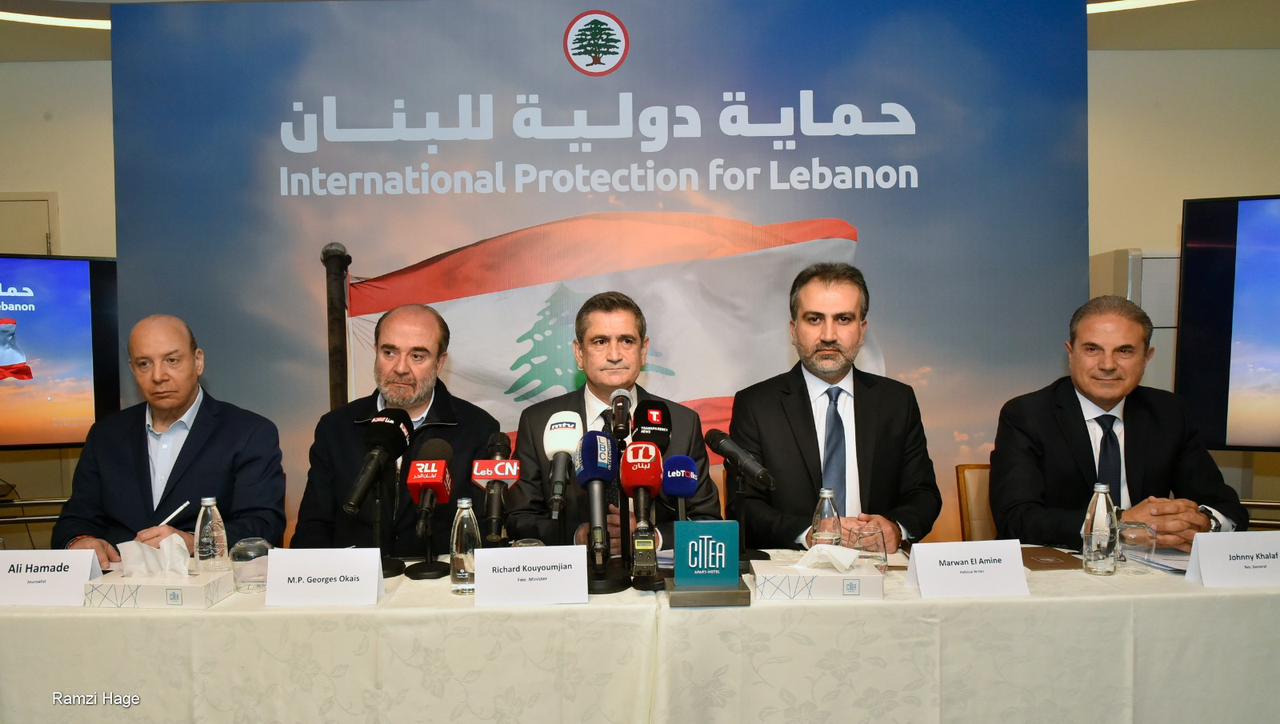
The External Relations Apparatus held, on Wednesday, April 22, 2026, a conference titled “International Protection for Lebanon” at Citéa Apart Hotel in Achrafieh, as part of follow-up efforts to the recommendations of Maarab 3, and based on the United Nations Charter and UN Security Council Resolutions 1559, 1680, and 1701.
The conference brought together political, media, and diplomatic figures, including MPs, ministers, journalists, and representatives of Arab and foreign embassies, alongside Lebanese and international speakers participating both in person and via video.
Former Minister Richard Kouyoumjian opened the conference by welcoming attendees and emphasizing that the concept of “international protection” aligns with the commitment of Lebanon’s international partners to assist the country through its current critical phase. He stressed that while protection is fundamentally the responsibility of the Lebanese state, seeking international assistance becomes necessary when state institutions are unable to fulfill this role.
Kouyoumjian highlighted the urgency of implementing Lebanese government decisions issued on August 5 and 7, 2025, and March 2, 2026, particularly those related to restricting arms to the state and disarming Hezbollah. He noted that continued inability to enforce these decisions could justify requesting international intervention under Chapter VII of the UN Charter.
MP Georges Okais addressed the legal dimensions of international protection, explaining the mechanisms available under Chapter VII and the conditions required for such intervention, including the exhaustion of internal and diplomatic solutions and the existence of a genuine threat to peace.
In a video address, U.S. Congressman Darin LaHood reaffirmed his support for Lebanon, describing the current moment as a “historic opportunity” for the country to strengthen its sovereignty and distance itself from external influences. He emphasized continued U.S. support for the Lebanese Army and state institutions.
Political analyst Marwan Al-Amin focused on the situation in southern Lebanon, arguing that lasting protection begins with safeguarding the region and its residents. He underscored the need for a strategic shift toward state authority and sustainable stability.
European Parliament member François-Xavier Bellamy stressed that Lebanon’s security depends on restoring full sovereignty, calling for the disarmament of non-state actors and stronger European support for Lebanese institutions.
Retired Brigadier General Johnny Khalaf highlighted the importance of a unified military authority, emphasizing that the Lebanese Army must remain the sole legitimate force responsible for national defense.
EU Commissioner for the Mediterranean Dubravka Šuica reaffirmed the European Union’s commitment to supporting Lebanon, including financial assistance and programs aimed at strengthening public services and institutional resilience.
In his concluding remarks, journalist Ali Hamadeh noted that the concept of international protection arises when the state is unable to fully exercise its responsibilities. He stressed that while significant political decisions have been made, the primary challenge remains their implementation.
The conference concluded that the call for international protection does not imply external guardianship, but rather aims to support the Lebanese state in restoring full sovereignty, consolidating its institutions, and ensuring that decisions related to war, peace, and arms remain exclusively in its hands.