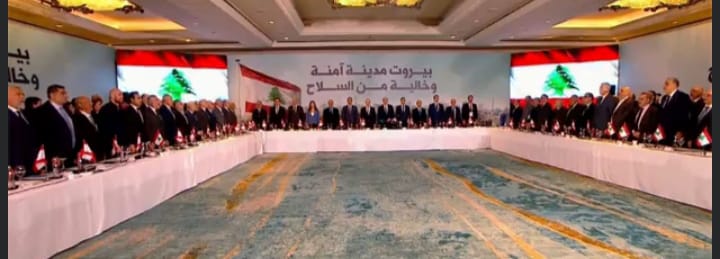
MP Nicolas Sahnaoui affirmed during the “Beirut, a Demilitarized City” conference that “we are meeting at a critical moment in Lebanon’s history, where security risks intersect with social concerns, placing a greater responsibility on us to protect our capital and preserve national unity.”
He stressed that Beirut has never been an exclusive city or owned by any single group, but rather a shared space for all Lebanese, and historically a refuge for the region.
Accordingly, any approach to its security must aim to preserve this role, strengthen unity, and avoid deepening divisions.
Sahnaoui noted that the Free Patriotic Movement rejects any aggression against Lebanon, while also refusing to drag the country into wars that do not serve its interests or into conflicts beyond its capacity. He emphasized that protecting all Lebanese requires a strong and just state that monopolizes arms while remaining capable of defending its land and people. He added: “We do not want anyone to feel targeted or excluded, as stability cannot be built by targeting any Lebanese component, nor can civil peace be preserved through divisive rhetoric.”
He underlined the need for a calm national approach that rebuilds trust between the state and its citizens, and among the Lebanese themselves, stressing that the monopoly of arms in the hands of the Lebanese Army and legitimate forces is a fundamental condition for statehood.
He added that this is a collective government responsibility, requiring real guarantees for all Lebanese to ensure no one feels defeated, and that the victory of an inclusive state is a victory for all.
Sahnaoui also pointed out that Beirut needs not only security but also reassurance, and a comprehensive state presence—social, developmental, and humanitarian—to remain a city of life, not fear. “Beirut is not a detail in Lebanon; it is its image and balance. Either we protect it through the state and protect Lebanon, or we leave it to chaos and open the door to the unknown,” he said.
For his part, MP Edgar Traboulsi, a member of the “Strong Lebanon” bloc, stated that “Beirut does not die. It is a city that has endured earthquakes, wars, internal conflicts, and various occupations. Its buildings may be destroyed and its people may fall, but it does not die.”
He emphasized that Beirut needs more than conferences to ensure it is free of illegal arms and self-security, calling for unity among all its residents without exclusion, and protection from extremism, superiority, and divisive rhetoric.
Traboulsi stressed that what Beirut demands from the Lebanese government applies to all of Lebanon, urging authorities to act in the interest of all citizens and safeguard national dignity. He highlighted the need to preserve Lebanon’s sovereignty over its entire territory—its 10,452 square kilometers—and to resist both internal and external pressures that could lead to harmful decisions.
He concluded by warning that the region is witnessing the fragmentation of states, stressing the need to build a unified and sovereign Lebanon, free from external alignments, and recalling the lessons of the 1975 war, emphasizing that Lebanon’s unity and civil peace must remain above all considerations.