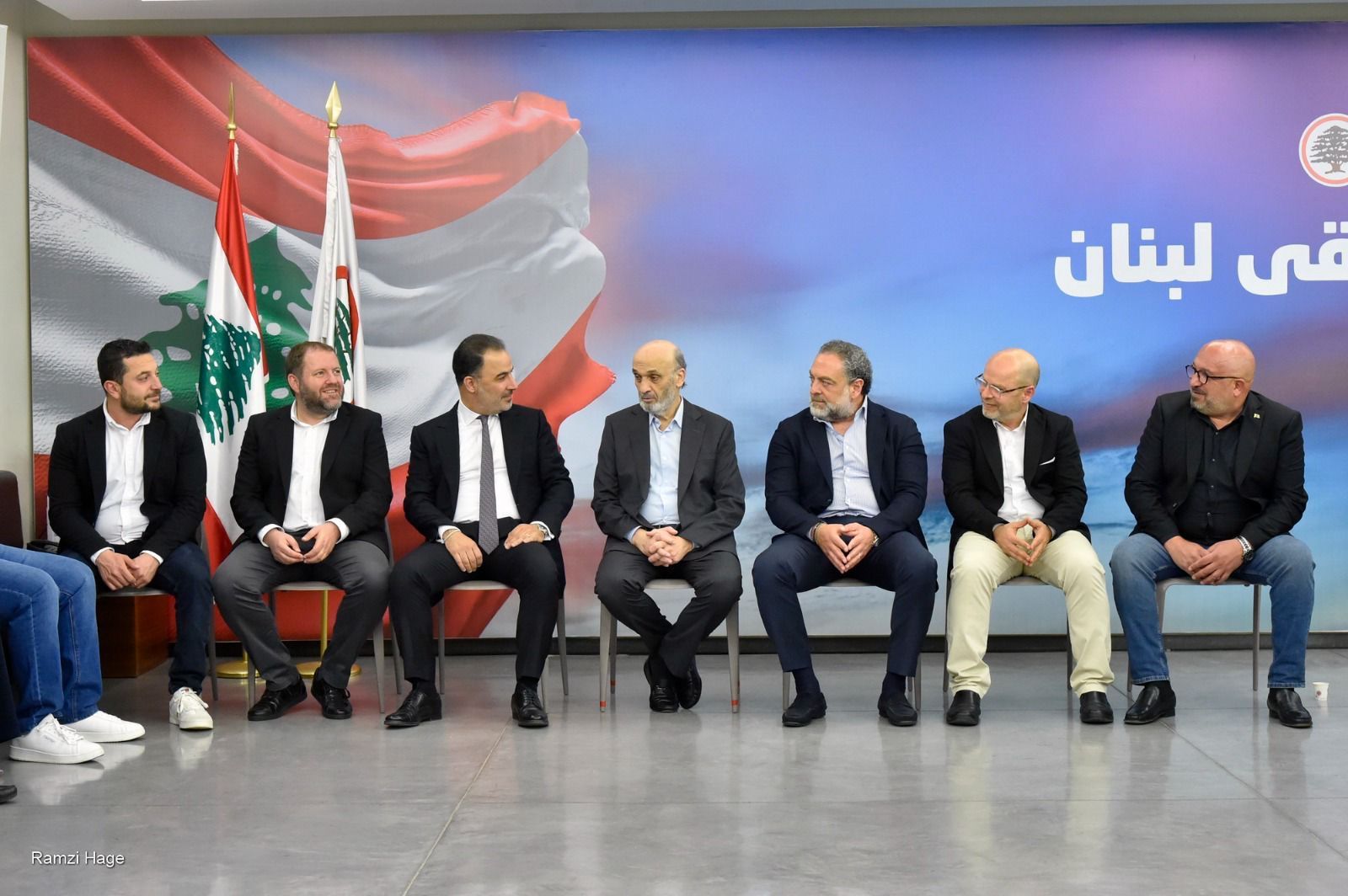
Lebanese Forces party leader Samir Geagea met at the party’s headquarters in Maarab with the Zahle Municipal Council, headed by Salim Ghazaleh and Vice President Ziad Shaanin, in the presence of Strong Republic bloc member MP Elias Estefan and regional coordinator Alain Mneiyer.
Geagea and those present discussed the country’s general situation, while the municipal council outlined to him the reality of the city of Zahle, particularly with regard to the repercussions of the war, the displacement file, and the city’s development needs.
For his part, Geagea praised the municipal council’s performance during the first year of its term, commending its work and calling on الجميع to continue with the same approach and spirit they had shown over the past year, especially in serving all the people of Zahle without any discrimination and in adopting the highest standards of transparency, integrity, and credibility in managing public affairs.
Following the meeting, the mayor thanked “the Hakim” for hosting them and said: “We meet on this occasion about a year after the municipal elections and the launch of the ‘Heart of Zahle’ list, which was crowned with the confidence of the people of Zahle. For us, that confidence was not merely an electoral victory, but a great trust placed upon our shoulders and a daily responsibility that we strive to bear so as to live up to it.”
He noted that their visit came first to thank the Lebanese Forces, which had not missed any opportunity over the past year to support them through the leadership, the MPs, and the regional coordinator, at key junctures that helped ensure the success of a large number of projects and files concerning the city and its residents. He pointed out that this support “was never conditioned on any demand, nor was it accompanied by any interference in municipal work. Rather, it was based on one clear and explicit principle: the application of the law,” considering that this principle “is not a detail, but the foundation of municipal work, because the project of building the state and its institutions is a project that belongs to all of us.”
He stressed that “Zahle has been and will remain at equal distance from الجميع, open to all Lebanese, siding only with the interests of its people and looking only toward the establishment of a strong state.”
He pointed out that during the past year the council had faced “major challenges, foremost among them the war that affected all of Lebanon,” noting that it dealt with the displacement file “with full responsibility,” as Zahle was able to become “a host to more than 8,000 displaced people,” while at the same time preserving “security, public order, and dignified living for all.” He explained that the city “opened its doors with humanity, but acted with responsibility, and succeeded in ensuring the continuity of municipal services despite all circumstances.” He added: “Zahle was open, but it was also firm; humane, but committed to the law,” considering that this “is the model we believe in and seek to sustain.”
On the development front, he pointed to “clear progress in key files, from lighting to fee collection, passing through surveillance systems, road organization, and the activation of public spaces, in addition to tourism initiatives such as festivals and the Christmas village, strengthening partnerships with the private sector and associations, and opening up to the outside world.”
He concluded by affirming “our commitment before our people and before public opinion to remain faithful to this trust, to continue on this path, and to extend our hand in cooperation with الجميع, out of our belief in our ability to build a modern, safe, and orderly city,” stressing that “Zahle will remain a city of law and a home for all Lebanese.”