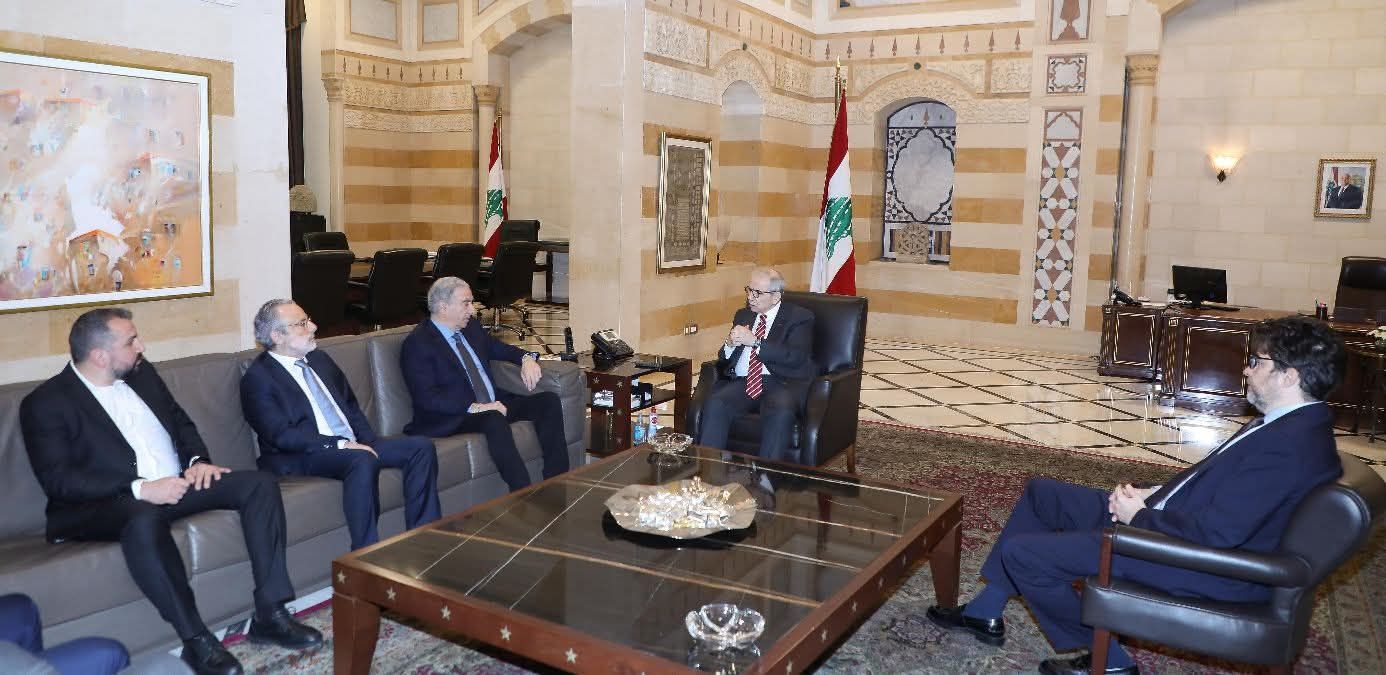
Prime Minister Dr. Nawaf Salam received former minister Michel Pharaon at the head of a delegation that included the head of the Ashrafieh Traders Association, Tony Eid, Beirut Municipal Council member Joelle Murad, and Messrs. Shafik Badr and Alain Khabbieh.
After the meeting, Pharaon said:
"At the outset, it is necessary to commend the Prime Minister and the President for their insistence and steadfastness, and for the efforts that were made and led to the ceasefire, in the hope that this will move beyond the truce stage and result in a permanent cessation. This track was achieved with the support of Lebanon’s friends and through the pressure exerted by the United States, which helped consolidate the ceasefire in preparation for reaching a lasting agreement.
This track is linked to the ongoing negotiations, which also came as a result of clear determination and efforts, and led to the separation of tracks, so that there is now an independent Lebanese track within these negotiations, despite their difficulty and complexity amid the interwoven strands of the Lebanese crisis.
In parallel, the project of a ‘demilitarized Beirut’ emerged as one of the main headings. This is a project that was put forward in cooperation with civil society forces and figures and authorities that had called for it since August. Although the priority at an earlier stage was the deployment of the Lebanese Army north of the Litani, this project has now become no less important than consolidating the ceasefire.
In this context, the anticipated contradictions in international positions, particularly the American one, cannot be ignored, as the success of any plan remains contingent on Beirut being free of weapons. The presence of missiles inside the capital cannot be accepted, and no party can oppose the principle of disarming it, given the essential role this would play in consolidating stability, reassuring citizens, and strengthening confidence in the economic situation.
This stability encompasses various vital facilities, from the Port of Beirut to hospitals and other public institutions, provided that the success of this experience serves as a gateway to expanding it toward Greater Beirut, ultimately leading to the implementation of a broader plan to confine weapons across all Lebanese territory.
Despite the sensitivity of this stage, the Prime Minister appeared determined to make this step succeed, while the state is now throwing its weight behind this initiative because of its great symbolism. Its success in Beirut would constitute a major national achievement that would lay the foundation for a new phase of stability.
This track is not separate from the broader plan whose elements are mutually complementary, including the financial reform track, which is today the محور of negotiations in Washington, where the Prime Minister had been scheduled to head given the importance of this file.
In sum, these tracks, despite their differences, appear interconnected and complementary, with each constituting an essential element in the path to saving Lebanon and putting it on the road to recovery, leading to what could be the beginning of Lebanon’s path to salvation."