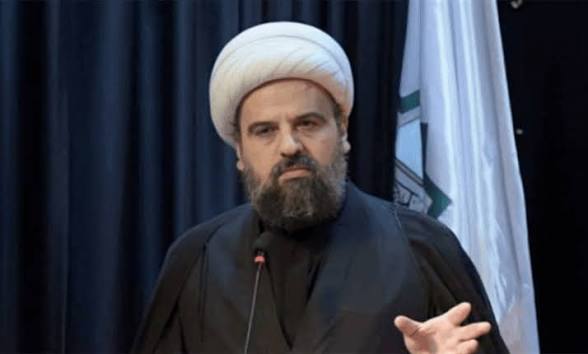
Jaafari Grand Mufti Sheikh Ahmad Qabalan invoked “the memory of the civil war” and said in a statement: “Because we are at the heart of a major national crisis, because the country’s internal reality is boiling intensely and is open to every possibility, because the civil war and preventing it are tied to the explosive causes behind it and to what is required to avert it, because those riding power today are trapped by commitments that sharply conflict with Lebanon’s national interests, because this country, as usual, moves from one mandate to another, because those riding power today are the product of the new American mandate, and because this fateful war is reshaping the country, the region, and the entire Middle East, it was necessary to present a critical review of the civil war that formed the core of Lebanon’s disasters.”
He added: “Here we say, with complete objectivity, that any critical review places us before the catastrophe of Lebanese catastrophes: the racist sectarian Lebanese authority that was formed through the occupying French mandate to serve France’s interests, not Lebanon’s. Despite the disastrous impact of this on Lebanese civil rights, those who mounted this authority at the time turned into racist kings and sectarian despots in every sense of the word. Faced with this kind of power practice obsessed with racism, the other sects were driven to seek their Lebanese interests outside Lebanon. The Palestinian issue can never be separated from the racism, despotism, and injustice of the Lebanese authority adopted by the French mandate. Whoever reads Charles Debbas, Habib Pasha al-Saad, Emile Eddé, and Alfred Naccache, then reviews the legacy of Beshara al-Khoury and Camille Chamoun up to Bachir Gemayel, will strongly understand what I mean.”
He continued: “Patching up national pacts has not revived the country and will not revive it, because the fundamental crisis lies in structural sectarianism and the political-financial elites that have worked and continue to work to exploit poisonous sectarianism through programs and policies that wrong their country and its people in favor of projects tied to filthy international and regional dependency. Even the Taif Agreement, as a transitional phase, failed to transform this farm-like country into a homeland, or even half a homeland, because of the complex of regional and international mandate mixed with political extortion and absurdities. Today, we must live the memory of the civil war through its causes and the nature of what is required in response to it, because history repeats itself through its causes. We are now at the heart of a tremendous upheaval and a moment open to every possibility. Those monopolizing power today are stumbling blindly and leaping over the most dangerous landmines that could blow up the country. In doing so, they are placing Lebanon at the center of a complex web of the worst causes of civil war. If this camp insists on antagonizing its nation’s interests and remains captive to its humiliating dependency on Washington—and what Washington means in terms of Tel Aviv’s interests—it will push the entire country toward an unprecedented civil war. Out of supreme necessity, this camp must realize that its bet on America and Israel is an absolute losing bet. The era of America as the world’s policeman is being buried in the Strait of Hormuz and beneath the rubble of American bases in the Gulf, while Israel’s mighty or major forces are being destroyed in Khiam, Bint Jbeil, and all along the front edge of south Lebanon, whose sovereign resistance this camp is fiercely trying to eliminate.”