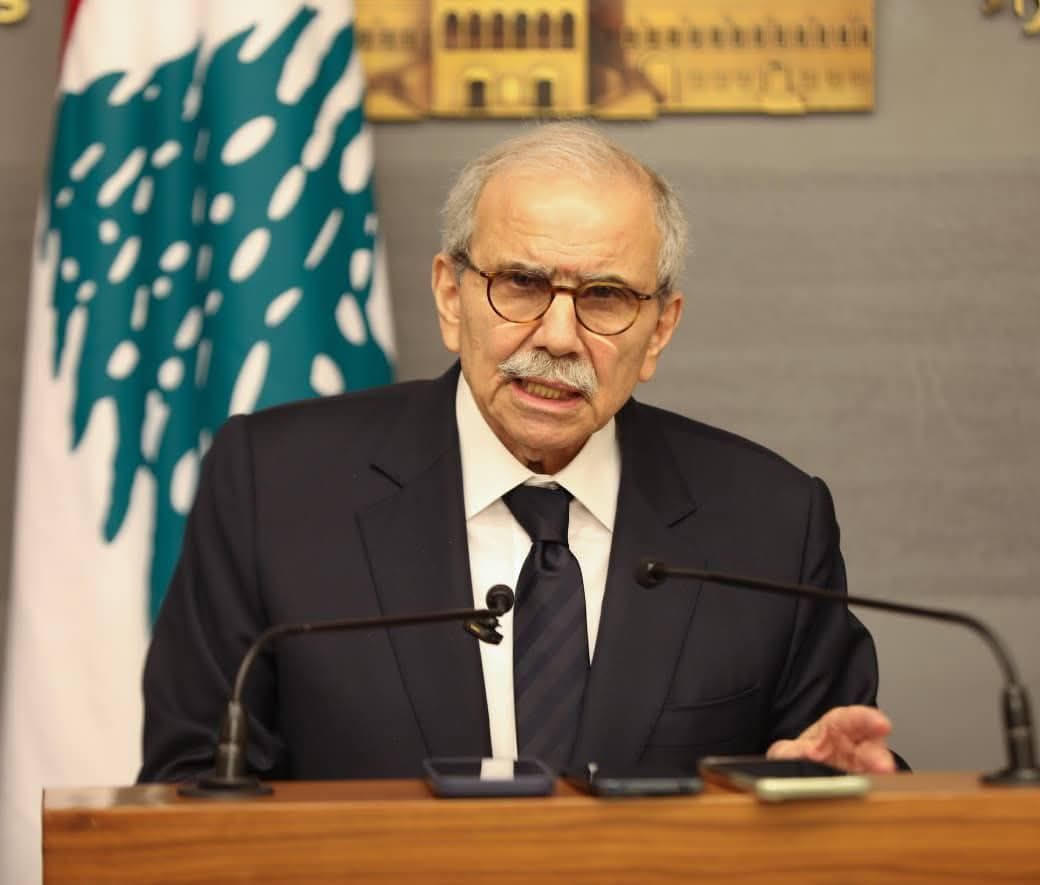
Prime Minister Nawaf Salam’s address on the eve of the anniversary of the outbreak of the civil war on April 13:
Some of us erred when they burdened Lebanon with more than it could bear, prioritizing solidarity with just causes at the expense of the requirements of protecting the country’s sovereignty and security.
Others also erred when they believed Lebanon’s weakness could be turned into strength. And everyone who sought external support, imagining that this outside power had no aim other than backing them, was mistaken, only to find themselves captive to a game bigger than themselves.
I address you today at another tragic turning point in our history, where hearts are weighed down by the painful feeling that the voice may not be heard, and that suffering does not always find those who will do it justice.
I know, and fully understand, the pain of those who have lost their loved ones, their homes, their villages, and their olive groves, and of those who today find themselves moving from one shelter to another.
I understand your anger, and your need for your voice to be heard, even at the doors of the Grand Serail.
I also understand the anxiety and anger of those who can no longer bear a fate they did not choose for themselves, a fate shaped by the will of others, even through war.
And I know that the memory of August 4 has not healed, especially for my people in Beirut, and that it was recalled in all its cruelty with the tragedy of April 8 and its unarmed civilian victims.
I know that you are tired of having your right to determine your own destiny taken from you.
I feel the pain of the mother who lost her son, a fighter on the front, just as I feel the pain of the mother who lost a child who did not choose this war and asked only to live.
I know that all of you are suffering… more than can be borne, and for a very long time.
I also realize that what has been a source of richness for this country—its diversity—can at times turn into a factor of division. You carry within your conscience a shared memory, alongside differing memories and experiences.
My responsibility is to strengthen what unites these memories, to ease their tensions, and to bring them closer together as much as possible.
And my people in the south know better than anyone the cost of wars, divisions, and misguided wagers. Over decades, they have paid the price of occupation, attacks, and displacement, and they have also paid the price of multiple centers of decision-making and the absence of the state or the weakness of its presence.
From here, it is our national duty today to affirm that the south will not once again be left alone in the face of fear, destruction, and anxiety over its fate. Its protection, like the protection of all Lebanon, can only be secured through one strong and just state.
We will continue to work to stop this war, secure the Israeli withdrawal from all our territory, recover all our prisoners, rebuild our destroyed villages and towns, ensure the safe return of our displaced people to them, and enable them to live there in dignity and security.
To this end, we are continuing our efforts to stop the war, foremost among them the initiative put forward by the President of the Republic to negotiate an end to the war and to enable the legitimate state institutions to fully carry out their role in protecting Lebanon and all Lebanese.
So let us all return
to what we accepted as a pact among ourselves, not only to end the civil war, but to build the state we seek: the just and strong state, the one state that embraces all its citizens. What is meant here is the Taif Agreement. Let us implement its provisions in full, correct what was applied contrary to its text or spirit, work to close the gaps that practice has revealed, and develop it whenever the need arises.
Since the Taif Agreement called for extending the authority of the state over all its territory through its own forces—and this is something we have not done since the agreement was adopted—its implementation would provide security and safety for all citizens and allow the rule of law to prevail across the country and over الجميع equally. No one should be above the law or outside it.
The dignity of the homeland is the dignity of all of you, without discrimination. And if preserving it today requires humility and responsibility, then I am committed to that… and I call on all of you to hold fast to what unites us, in protection of our homeland and the future of our children.
Let us together confront the dangers surrounding us with reason, unity, and national responsibility.
Our unity today is not an emotional slogan, but a national necessity.
All of us are for the homeland,
and the homeland belongs to us all.