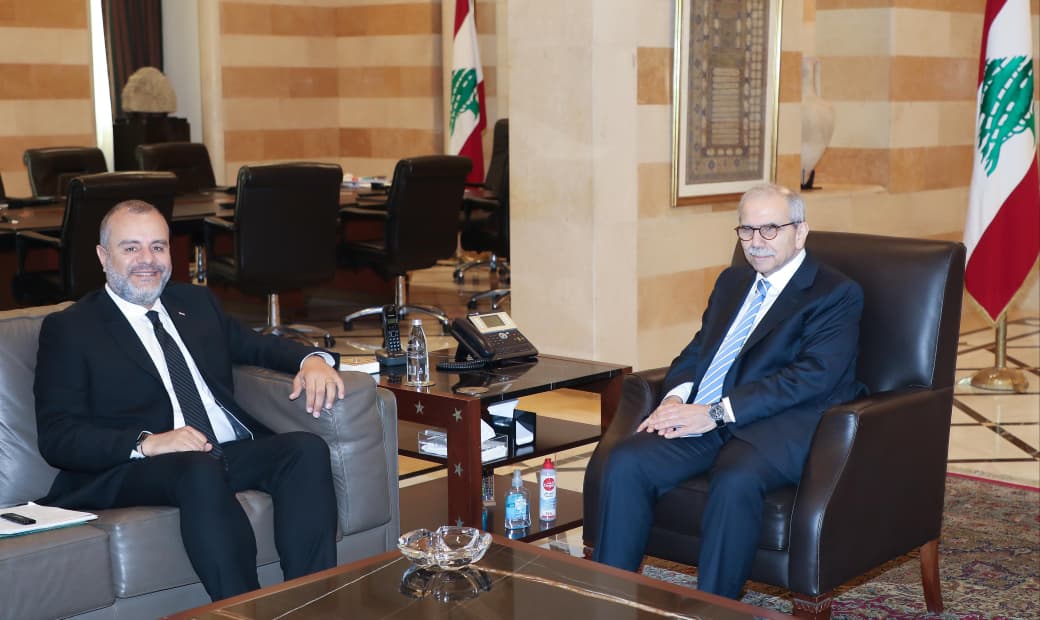
Prime Minister Dr. Nawaf Salam received MP Adib Abdel Massih, who said after the meeting:
"Today, I had the honor of paying a supportive visit to His Excellency the Prime Minister, Judge Nawaf Salam, during which I praised his efforts, his love for this country, and his exceptional commitment to sovereignty. I would like to stress the word ‘exceptional,’ because these days we must be extremely vigilant about the concept of sovereignty.
There is a Prime Minister who is keen on Lebanon’s sovereignty and does not compromise on issues of sovereignty, and this formed an essential part of my visit to him.
We also discussed the historic meeting held yesterday in Washington at the US State Department, which was described as a preliminary meeting to be followed by others, with the aim, first and foremost, of reaching a ceasefire. God willing, this can be achieved through the diplomacy being pursued by His Excellency the President of the Republic and His Excellency the Prime Minister.
Today, I also came to reaffirm my support for the Lebanese state — a state that was previously absent in favor of a mini-state within the state — whereas today we see the Lebanese state, represented by its two presidents, His Excellency the President and His Excellency the Prime Minister, carrying out tremendous work as a unified and cooperative executive authority, hand in hand, in order to restore Lebanon’s sovereignty on the one hand, and to stop the war and establish peace on Lebanese territory on the other.
I presented a number of ideas to His Excellency the Prime Minister, which I will work on summarizing, and I also conveyed to him appeals from some regions and villages.
In this context, I raised the issue of the possibility of Lebanon declaring its accession to, or submitting a declaration of jurisdiction before, the International Criminal Court in order to open an investigation into crimes committed on Lebanese territory by all foreign forces, whether Israeli or non-Israeli. He is interested in the matter and is preparing the required files in anticipation of the possible submission of a declaration accepting the Court’s jurisdiction in accordance with Article 12, paragraph 3, of the Rome Statute. It is said that this track is being followed by specialized legal bodies, and it is considered important to enable the state to prosecute those responsible for the crimes and seek compensation for all the killing and destruction that took place on Lebanese territory.
I also addressed the issue of declaring a state of emergency in a number of areas through a decree issued by the Council of Ministers, which would grant the Lebanese Army and the security services the necessary powers to maintain security, prevent any breakdown, and keep the specter of war and destruction away from these areas.
In the same context, I stressed the need to secure safe humanitarian corridors for the steadfast villages in the south, particularly Mays al-Jabal, Kfarkela, Debel, Aitaroun, Ain Ebel, Taybeh, Aainata, Aita al-Shaab and others, in a way that ensures the delivery of essential supplies and the protection of civilians.
I also proposed establishing a field hospital in these areas in light of the urgent need for immediate health services amid the ongoing war, along with opening safe corridors to reach it. In this regard, support could be sought from more than one international and humanitarian body, such as UNIFIL and the International Committee of the Red Cross, in addition to sisterly and friendly countries that have previously supported Lebanon with field hospitals, such as Morocco and the United Arab Emirates, to cooperate in this vital area.
Finally, I raised the issue of public sector employees, where there is a disparity in the mechanism for extending the retirement age among different categories. Some military categories are granted extensions for specific periods, while other employees are sent directly into retirement without similar treatment, creating an imbalance in the principle of equal opportunity and affecting their living conditions under the current circumstances and inflation rates approaching 35 percent. From this standpoint, I proposed the idea of adopting a unified extension for public sector and public institution employees for a period of no less than one year, in a way that provides them with a measure of stability and protects their rights at this stage."