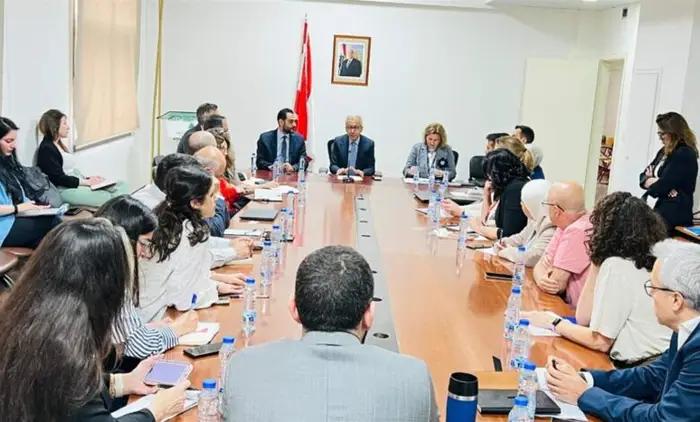
The Ministry of Economy and Trade held a high-level coordination meeting dedicated to discussing mechanisms for urgent support to micro, small and medium enterprises (MSMEs), with broad participation from ambassadors and representatives of international donor bodies, financial institutions, microfinance entities, and development partners.
During the meeting, Minister of Economy and Trade Amer Bisat affirmed that Lebanon has been facing a compounded economic and social crisis for years, worsened by recent developments. He noted that the ministry had taken the initiative to bring together international partners, foremost among them the European Union and the World Bank, in addition to local institutions, with the aim of unifying efforts and accelerating support directed to the productive sector.
Bisat pointed out that small and medium enterprises constitute the backbone of the Lebanese economy, having represented about 95% of all registered companies before the crisis and contributed nearly 40% of GDP, in addition to their key role in providing more than half of formal-sector jobs.
He stressed that the most prominent challenge facing these enterprises is the lack of liquidity, which requires the provision of operating grants and flexible financing mechanisms that would enable them to continue and remain resilient under current conditions.
He revealed that the ministry had completed a preliminary survey covering around 200 companies and is working in cooperation with the United Nations to expand the scope of the study in order to identify actual needs more accurately, ensuring that support is directed to the hardest-hit entities.
The meeting showed notable readiness among donor parties to strengthen funding allocated to this sector, alongside agreement to redirect part of previous allocations toward the most urgent needs.
The discussions also addressed the possibility of enhancing coordination between the Ministry of Economy and the Ministry of Social Affairs, allowing for the activation of the “Aman” mechanism and the broader use of “Cash for Work” programs in a more effective and targeted manner.
The minister estimated the available support at around $130 million, including grants and concessional loans provided by the World Bank and a number of donor countries, including Norway and Canada, stressing the importance of swiftly turning these pledges into operational programs that reach beneficiaries directly.
At the conclusion of the meeting, Bisat underscored the need to adopt the highest standards of governance and transparency in managing these funds to ensure their effectiveness and achieve the desired economic and social impact, warning that slow implementation or fragmented efforts could lead to the loss of businesses capable of surviving and contributing to economic recovery.
تابع آخر الأخبار أولاً بأول على قناتنا في واتساب
تابعنا