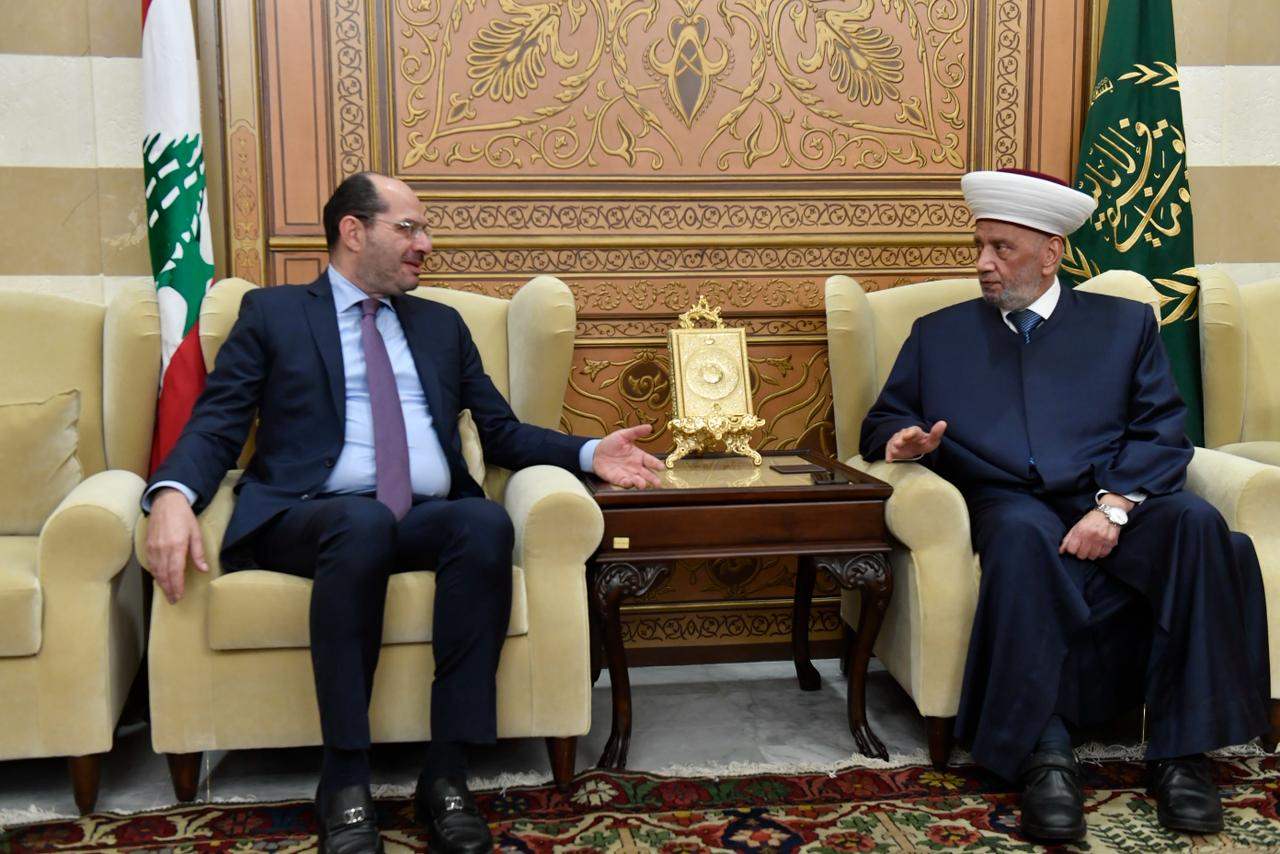
MP Hassan Murad announced that “we were honored today, in these difficult circumstances and on this sad day in Lebanon’s history, to meet His Eminence the Grand Mufti of the Lebanese Republic, Sheikh Dr. Abdel Latif Derian, amid the barbaric war being waged by the Israeli enemy against our country.”
During the meeting, Murad condemned in the strongest terms the ongoing Zionist attacks on Lebanon and Arab and Islamic countries, considering that the crimes committed by the enemy against civilians rise to the level of fully fledged war crimes, particularly the terrorist massacre committed in Beirut last week. He called on the Lebanese government to move immediately to prepare a comprehensive legal file to prosecute the enemy before the relevant international bodies and courts.
Murad explained that “we asked His Eminence to urgently call for an inclusive Islamic spiritual summit at Dar Al-Fatwa, in order to unify the Islamic position in the face of sedition and to stress rejection of being dragged in the streets behind the enemy’s schemes aimed at undermining our internal unity.”
He added: “With His Eminence the Mufti, we recalled the Municipal Stadium prayer called for by the martyred Mufti Sheikh Hassan Khaled to unify the Islamic ranks at the height of the division caused by the civil war, and its importance at the time. We called on him to invite to a broad Islamic conference at Dar Al-Fatwa, with the participation of scholars and figures from various regions, to develop a clear vision that fortifies the domestic arena and strengthens the discourse of moderation and unity.”
Regarding the negotiation file, Murad stressed that any serious approach must be based on clarity of vision, firmness of positions, and not squandering Lebanon’s elements of strength, affirming that “negotiations, whatever their form or course, derive legitimacy only from national consensus, adherence to the resolutions of the 2002 Beirut Summit and the Riyadh Summit, and alignment within the broader Arab position.”
He considered that departing from these foundations constitutes a unilateral approach that does not serve the national interest, stressing that the constants related to Lebanon’s unity, sovereignty, and territorial integrity remain a non-negotiable red line.
He also stressed the importance of embracing the displaced from the affected areas, calling for the combined efforts of the state and society to strengthen solidarity, considering this responsibility to be national, moral, and religiously mandated.
On the domestic front, Murad stressed that freedom of differing opinion is a legitimate right guaranteed by the constitution, but he rejected any offense to the position of the Presidency of the Council of Ministers, given what it represents as a national symbol and an inclusive constitutional institution.
He concluded by affirming that the current phase is among the most delicate in Lebanon’s history and requires unity of position and firmness in principles to confront the aggression and counter attempts at fragmentation and division, stressing the need to stand together to protect Lebanon and its people.