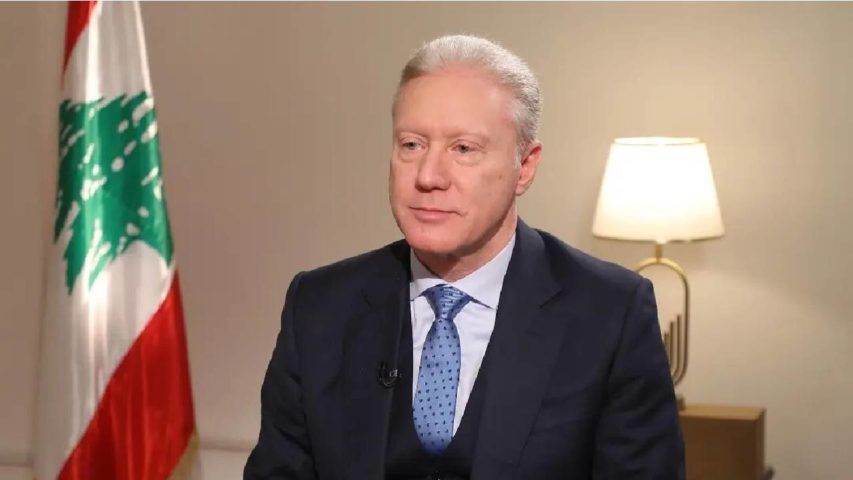
Foreign Minister and Emigrants Youssef Raggi affirmed that Lebanon has entered a new phase in the process of restoring state authority, noting that President Joseph Aoun’s visit abroad helped set the file of the pilot areas in motion after a period of stagnation, in parallel with the Lebanese Army beginning its deployment in the first of these areas.
Raggi explained, in an interview with the French newspaper Journal du Dimanche, that the main challenge lies in maintaining the momentum of the deployment and gradually expanding it to cover the entire south, leading to a stage in which Lebanon is free of any weapons outside the framework of the official military and security institutions.
Raggi reiterated that the agreement signed between Lebanon and Israel under U.S. sponsorship is a "framework agreement," considering that its provisions constitute the basis for upcoming negotiations. He noted that the Lebanese state made a clear decision about a year and a half ago to once again confine military action to the hands of the legitimate institutions.
He stressed that the government is pressing ahead with the project of fully rebuilding state authority, including ending any military structure outside its institutions, emphasizing that the priority remains addressing the weapons file before moving on to any other discussions related to the political path of any party.
Speaking about Hezbollah, Raggi clarified that the issue is not linked to the Shiite sect, but to the party as a political and military organization, noting that the state distinguishes between Lebanon’s various components and the question of the exclusive possession of weapons by the state. He said that a broad segment of the Lebanese, including groups within the Shiite community, wants the state to fully reclaim its role, even if some avoid expressing that publicly because of security fears.
Raggi said that Lebanon is experiencing, for the first time, a government with a clearly sovereign orientation, noting that the state has begun to show its ability to reclaim the security decision and that the Lebanese Army now possesses the capabilities required to carry out its role. He added that Hezbollah has suffered major military weakening, and that any potential challenge to the state would be linked less to possessing a missile arsenal than to the internal political track.
The foreign minister affirmed that the ultimate goal is to entrench the principle of the state’s monopoly over legitimate force, calling on the international community to continue supporting Lebanese institutions, especially the army, provided that this support reinforces the state’s decision rather than replacing it.
Regarding the U.S. role, Raggi said that Washington has the greatest ability to influence Israel, which is what prompted Lebanon to accept its mediation in this process. He pointed out that the American side conveyed assurances to Beirut regarding the absence of any Israeli ambitions toward Lebanon, considering this an important factor in the process of consolidating the agreement.
As for the French role, Raggi affirmed that Paris still has an important role in Lebanon, whether in supporting institutions or the army, or in contributing to reconstruction and economic recovery, in addition to its continued cultural presence.
Raggi concluded by stressing that Lebanon’s future vision is based on an independent, sovereign state, free of occupation and illegal weapons, capable of restoring its prosperity and regional role, and opening a new chapter of stability and openness to the world.
تابع آخر الأخبار أولاً بأول على قناتنا في واتساب
تابعنا