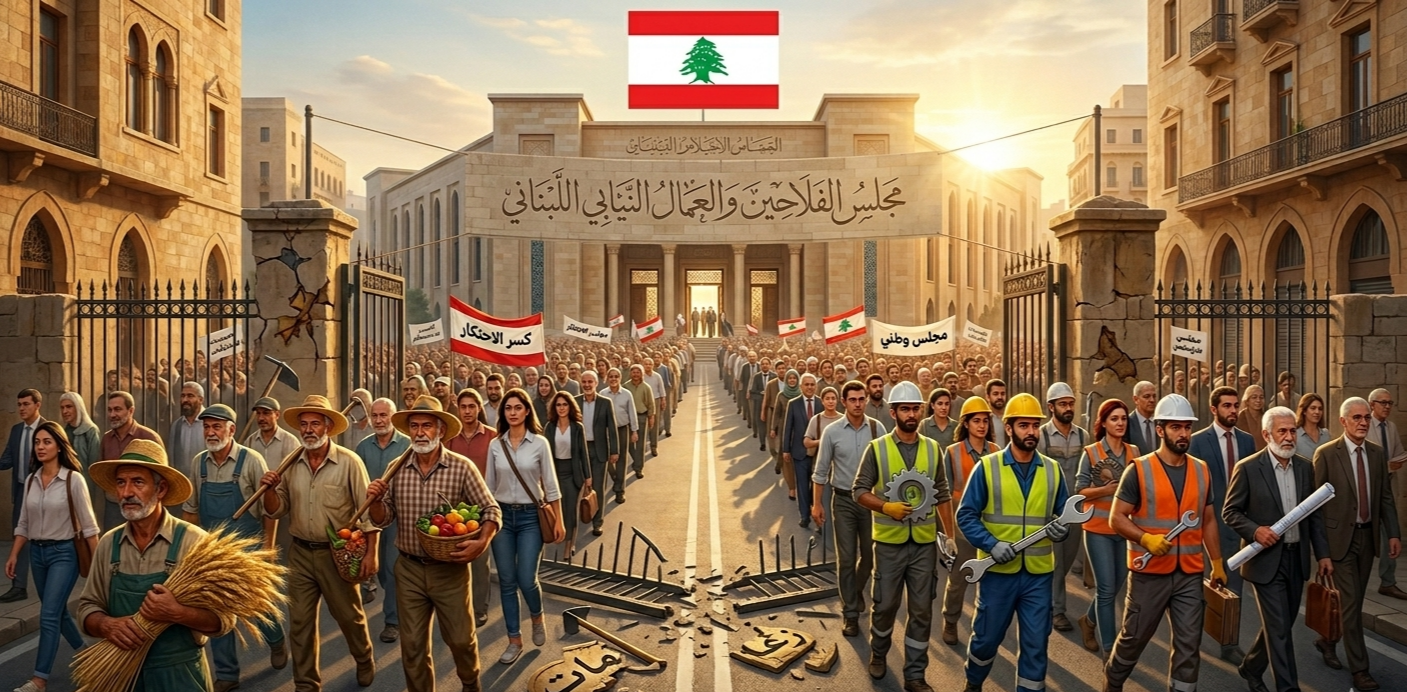
The country today appears to be standing at a sharp crossroads between a political phase exhausted by all its promises and slogans, and a moment in which the voices of people seeking real change are rising — change that is not limited to swapping faces, but extends to rebuilding the very idea itself: the idea of the state, justice, and genuine representation of the people.
It is no longer hidden from anyone that the political class that ruled for many long years has, in the eyes of a broad segment of Lebanese, become part of the crisis rather than part of its solution. Promises are repeated, crises accumulate, and trust erodes, while the citizen remains the weakest link in an equation weighed down by narrow calculations and intertwined interests. At every critical juncture, the same question returns: can a new path be produced with old tools?
The issue today is not lofty slogans, but the essence of political performance, which is no longer capable of keeping pace with the scale of the economic and social collapse. From here, the demand for change emerges as a national necessity, not a political luxury — change that restores value to the concept of public service instead of the logic of quotas, and to the state instead of the network of interests.
In this context, calls are mounting to open the way for a new generation of young people, especially from the poor and middle classes — those who live the details of daily suffering and know the meaning of high prices, unemployment, emigration, and anxiety over the future. These, according to a growing popular vision, are the most capable of understanding the people because they are simply part of them, not standing above them or far removed from their reality.
The entry of this generation into political life does not merely mean changing individuals, but introducing a different culture into public affairs: a culture of transparency, accountability, closeness to the people, and distance from the logic of privileges that have burdened the state and weakened its institutions.
But real change is not imposed by slogans; it is built through organization, awareness, and this generation’s ability to transform anger into a project, protest into a vision, and ambition into a workable program. The state is not built through reactions, but through studied choices and a long course of serious work.
Between the current reality and people’s aspirations lies a wide gap that can only be bridged by restoring the idea that power is not a privilege, but a responsibility. And when politics regains this meaning, change becomes possible, not merely a deferred dream.
In conclusion, the boldest and most pressing question at this moment of ongoing collapse remains: can a statesman rise and possess a decisive sovereign will, declaring clearly that the era of partisan alignments in their current form has come to an end, and that no legitimacy surpasses the legitimacy of the state and no authority stands above its institutions?
Can someone emerge who draws a clear line between the logic of the state and the logic of political mini-states, taking the courageous decision to reorganize political life on inclusive national foundations that abolish unequal privileges and redefine party work within a framework that serves the state rather than parallel it or compete with it?
This is not merely a call for an administrative decision or a formal measure, but for a foundational moment that restores the idea of the state as the sole point of reference, from which all legitimacy proceeds and to which all allegiances return. Only from there can one speak of a new beginning built on clear rules: the state first, and everything else within its framework, not outside it.