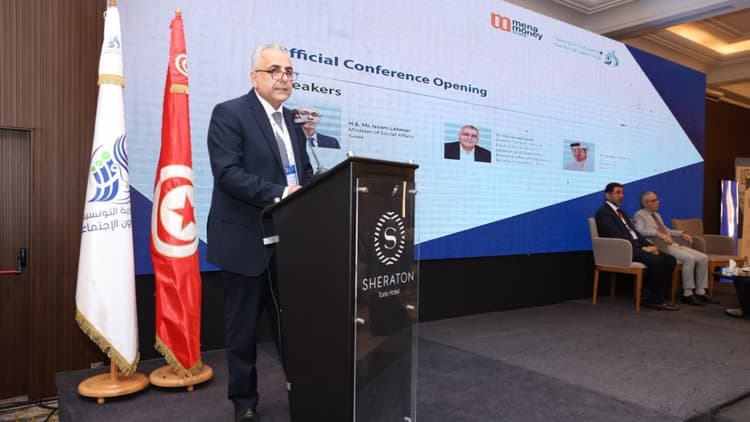
Dr. Mohammad Karki, Chairman of the Executive Bureau of the Arab Social Security Association and Director-General of the National Social Security Fund, announced from the Tunisian capital an Arab initiative to reform pension systems, stressing that advancing social protection has become a strategic necessity to ensure economic and social stability and keep pace with the rapid transformations in the labor market.
The initiative was launched during his participation in the proceedings of the Eighth Arab Pensions Conference, held in Tunisia under the theme “The Journey of Reforms Toward Pension Security,” under the patronage of Tunisian Minister of Social Affairs Issam Al Ahmar and in the presence of organizing committee chairman Ibrahim Khalil Ibrahim, alongside around 400 participants from social security and social insurance institutions and experts from international and regional organizations.
In his address during the opening session, Karki said that reforming pension systems must be based on a comprehensive vision built around five main tracks, beginning with strengthening financial sustainability through gradual and balanced reforms, expanding social coverage to include workers outside the formal economy and those working through digital platforms, and extending to the development of services through digital transformation, artificial intelligence, and data analysis.
He stressed the importance of strengthening Arab cooperation and coordinating insurance rights for workers among Arab countries, in addition to investing in institutional capacity-building and the development of human resources, considering that the success of any reform is linked to the presence of institutions that enjoy governance, efficiency, and sound management.
Karki noted that social security is no longer merely a system for providing compensation and benefits, but has become “a fundamental pillar of national stability, a driver of economic development, and one of the pillars of social justice,” pointing out that countries with strong social protection systems are better able to confront crises and protect their citizens.
He called for work to build Arab social protection systems that are more inclusive, fair, and sustainable, affirming that investing in people forms the basis of any secure future, and that reforming pension systems represents a direct investment in the economy and future generations.
He explained that the challenges facing social security institutions today differ greatly from those at the time of their establishment, as a result of economic, social, and demographic transformations, in addition to the emergence of new patterns of work imposed by the digital revolution and technological development.
He also pointed to the role of the Arab Social Security Association in keeping pace with these transformations and supporting reform programs in the areas of expanding coverage, strengthening financial sustainability, improving the level of benefits, digital transformation, and developing institutional governance.
Karki concluded by reaffirming the association’s commitment to continuing support for Arab cooperation, the exchange of expertise, and the building of partnerships, on the basis that social security constitutes “a contract of trust between the state and the citizen” and an essential element in consolidating stability and development, while expressing hope for the success of the conference and for its recommendations to be turned into practical steps serving Arab societies.
تابع آخر الأخبار أولاً بأول على قناتنا في واتساب
تابعنا