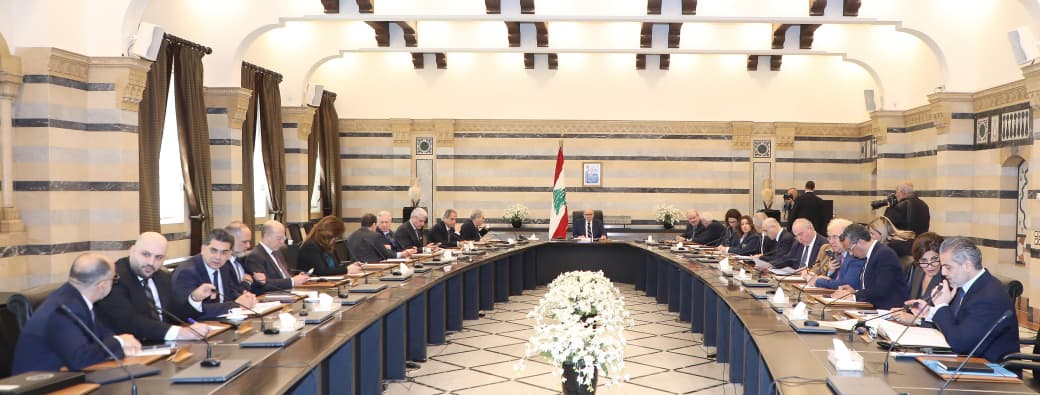
After the Cabinet session ended at around 1:45 p.m., Minister of Information Paul Morcos delivered the following official briefing:
The Council of Ministers convened at the Grand Serail under the chairmanship of Prime Minister Dr. Nawaf Salam to continue discussing the latest developments and their repercussions on the political, security, and social levels, particularly those related to the issue of displacement. The session was attended by the ministers and focused exclusively on this item on the agenda.
Prime Minister Salam began by referring to the ongoing diplomatic efforts aimed at halting the war and securing humanitarian support in light of the growing needs and demands related to displaced people. He also noted the upcoming visit of the United Nations Secretary-General to Beirut tomorrow, during which an urgent humanitarian appeal will be launched to mobilize food, medical, and other types of aid. He expressed gratitude to the countries that have already sent humanitarian assistance, notably Saudi Arabia, Jordan, France, the European Union, and Qatar.
Regarding the recent Cabinet decision concerning the Iranian Revolutionary Guard, Salam referred to a statement published by Iran’s Tasnim News Agency—statement No. 33 issued by the Revolutionary Guard—which indicated that a joint operation had been carried out with Hezbollah. The Prime Minister requested that the Minister of Foreign Affairs summon the relevant officials from the Iranian embassy in accordance with the provisions of the Vienna Convention.
Addressing a statement circulated in the media and on social media attributed to what was called “national officers,” Salam said the matter undermines the unity of the military institution. He noted doubts about the authenticity of the statement and stressed that the issue may fall under the Penal Code, particularly regarding actions that threaten the unity of the army, the country, and civil peace. He emphasized that the matter is not a media issue but a judicial one under the jurisdiction of the Public Prosecution.
The Minister of National Defense commented that the report appears suspicious and is currently being verified so that appropriate action can be taken.
The Cabinet also discussed the issue of social media and content that goes beyond the limits of freedom of expression, particularly incitement—whether against displaced persons, sectarian incitement, or calls for violence. Salam stressed that such acts fall under the Penal Code as crimes against national unity. At the same time, he reaffirmed that fundamental rights and freedom of expression must not be infringed upon, stressing: “We are against suppressing opinions, but we are also against incitement and sedition in all its forms.”
Speaking in his capacity as Minister of Information, Morcos said that since the beginning of the war he had issued two appeals—to journalists and to influencers and social media users—calling for awareness of the dangers of the current stage and urging them to avoid incitement, hate speech, and misinformation. He also referred to the specialized unit established by the Ministry of Information in cooperation with UNESCO, which has been activated to combat fake and misleading news.
Morcos further explained that, according to a detailed legal study he presented to the Cabinet, the Minister of Information has no authority over social media platforms, even in media-related matters. He clarified that the ministry is not a supervisory authority and does not possess judicial police powers; such responsibilities fall to the Public Prosecutor’s offices under the direction of the Minister of Justice.
Prime Minister Salam reiterated that acts such as incitement to violence or sectarian tension fall under criminal law and not under the Press Law, emphasizing that they are unrelated to media freedom and instead fall within the jurisdiction of criminal prosecution.
Several ministers intervened during the discussion, including the Ministers of Justice, Labor, and Health. The Minister of Health stressed that those spreading incitement do not represent the Lebanese people.
The Minister of Interior and Municipalities also spoke, noting that security incidents related to displacement remain very limited. He mentioned several arrests involving individuals carrying weapons who were referred to the judiciary, as well as ongoing verification of hotel guests’ identities. He also highlighted the work of the Civil Defense, ambulance services, and the security forces working alongside the army to maintain internal security.
The Minister of Social Affairs reported that 592 shelters have been opened so far, with 36 additional centers outside Beirut providing further accommodation capacity. The number of displaced persons has reached 126,438, while the number of registered displaced people has exceeded 822,000.
The Cabinet then listened to representatives from the Higher Relief Commission, the Council for the South, and the Central Disaster Management Room at the Grand Serail regarding the management of the displacement crisis, coordination with relevant agencies, and support for frontline villages with essential supplies.
Citizens who remain outside their homes were urged to move to available shelters, including the Camille Chamoun Sports City Stadium, while additional centers outside Beirut remain ready to receive them.
The Minister of Health outlined the work of primary healthcare centers and their coordination with displacement shelters. He said the situation remains under control despite increasing needs. He also reported that 22 medical teams had been targeted, resulting in 15 deaths and 45 injuries among medical personnel.
The total number of casualties has reached 687 deaths, including 98 children and 52 women, while 1,768 people have been injured, among them 304 children and 327 women.
Ministers also reviewed efforts undertaken within their respective ministries. The Foreign Minister addressed diplomatic contacts aimed at containing escalation and protecting civilian infrastructure. The Minister of Agriculture spoke about agricultural production, while the Ministers of Energy and Economy discussed fuel availability and pricing.
Daily briefings on the social situation and the condition of displaced persons will continue, with further details to be provided by the Minister of Social Affairs.
In response to a question regarding army measures on the ground, particularly in relation to the government’s decision to arrest armed individuals including armed Hezbollah members, and about displaced people still in the streets, Morcos said that the Minister of Interior had already addressed the issue of arrests, while the Minister of Defense presented a comprehensive overview. However, specific details on arrests were not discussed during this session since the matter had been addressed and approved in previous Cabinet meetings.
Regarding displaced people, Morcos said there is no reason for anyone to remain in the streets, as the government has 36 available centers capable of hosting them, in addition to remaining capacity at Sports City.
If needs increase, the government is prepared to open up to 100 additional centers.
Asked about diplomatic contacts to protect infrastructure, Morcos said the Foreign Minister had temporarily left the session to conduct international calls with his European and Western counterparts. These efforts, along with those of the President and the Prime Minister, aim to contain the escalation and prevent attacks from spreading to civilian infrastructure and vital facilities.
On measures to address incitement, Morcos said the Cabinet unanimously condemned incitement from any side and confirmed that the Public Prosecution must pursue those responsible. He reiterated that the Ministry of Information’s role is limited to awareness campaigns, guidance, training, and professional organization, while legal enforcement falls under the judiciary.
He also noted that the Media Law draft has reached the general assembly of Parliament and is expected to regulate electronic media platforms once adopted.
Finally, regarding relations with Iran, Morcos said the matter was clear: a statement had been published by Tasnim News Agency, prompting the Prime Minister to ask the Foreign Minister to summon the relevant officials at the Iranian embassy and take the appropriate measures in accordance with the Vienna Convention.