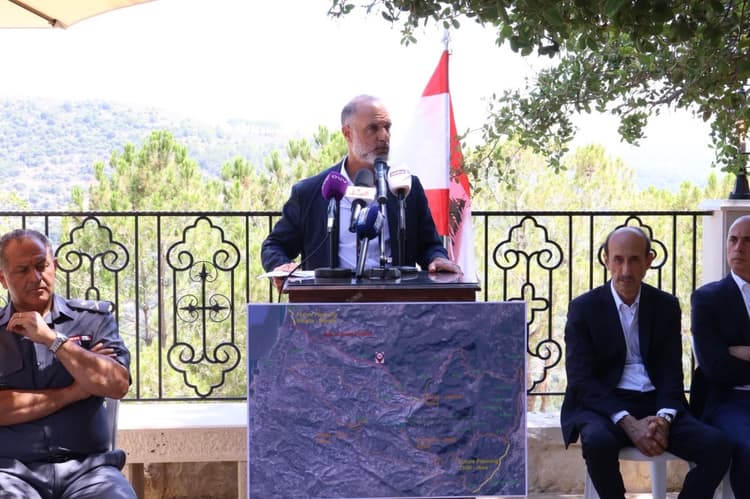
A statement from the Ministry of Public Works and Transport said the following:
Minister of Public Works and Transport Fayez Rassamni on Monday laid the foundation stone for the project to widen, maintain and asphalt the Kfarfalous–Karkha road and the Karkha–Bqosta–Awwali road, during a ceremony held at the entrance to the Shrine of Saint John the Baptist in the town of Karkha, marking the launch of a development project stretching about 12 kilometers and aimed at strengthening connectivity between the districts of Jezzine and Sidon, while improving road safety and traffic flow along this vital axis.
The ceremony was attended by the Greek Catholic Archbishop of Sidon and Deir al-Qamar, Bishop Elie Bechara Haddad, Bishop Maroun Ammar, and MPs Michel Moussa, Ghada Ayoub, Said al-Asmar and Charbel Massaad; Talal Qarqadan representing MP Osama Saad; former MPs Ibrahim Azar, Salim Khoury and Ziad Aswad; former minister Hector Hajjar; South Governor Mansour Daou; commander of the South Military Region Brig. Gen. Ahmad Abu Daher; Col. Haidar Qbeissi representing General Security Intelligence in the South; and head of South Intelligence Brig. Gen. Khaled Mansour.
Also taking part were head of the Sidon-Zahrani Municipalities Union and Mayor of Sidon Mustafa Hijazi, deputy head of the Jezzine Municipalities Union and Mayor of Karkha Jean Nakhle, mayors and mukhtars from the Jezzine and Sidon-Zahrani areas, Maroun al-Siqli, and the director of roads and buildings at the Ministry of Public Works and Transport, Pierre Maalouf, alongside religious, security, administrative, developmental and social figures, as well as residents of the area.
The ceremony opened with the national anthem, after which the shrine's priest, Father Walid al-Deek, introduced the occasion. Karkha Mayor Jean Nakhle then delivered a speech in which he stressed the importance of the project in improving connectivity between Jezzine and Sidon, easing pressure on the main road, and facilitating access to the Shrine of Saint John the Baptist, especially during religious seasons.
Nakhle also spoke about the contribution of businessman Charles Hanna, a native of Karkha, to establishing the shrine and turning it into a religious and tourist landmark. He revealed that a project is being studied to build a cable car linking the shrine to Deir al-Mukhallis in Joun, with its revenues to support the education and medical care of the area's residents.
He also conveyed Hanna's thanks to Minister Rassamni for supporting the project, and his apology for not attending because he is outside Lebanon. He thanked the President of the Republic for his support, Minister Rassamni for following up on the region's needs, and everyone who contributed to completing the project, especially Gaby Dib.
For his part, the Greek Catholic Archbishop of Sidon and Deir al-Qamar, Bishop Elie Bechara Haddad, welcomed Minister Rassamni and the attendees to Karkha and the Shrine of Saint John the Baptist, considering the launch of the project an indication that the state is once again paying attention to citizens' affairs. He praised the role played by the Ministry of Public Works and Transport as one of the ministries most closely connected to people's daily needs.
He also commended the approach adopted by Minister Rassamni in implementing development projects, thanking him and his team, especially Mr. Gaby Dib, for following up on the development of the shrine's entrances and the roads leading to it, and wishing them success in continuing projects that serve citizens and regions.
Minister Rassamni stressed that field tours are an essential part of his work because they allow him to directly assess citizens' needs and priorities, noting that he had inspected the road before the ceremony and examined the condition of this vital axis linking the districts of Sidon and Jezzine, and the growing pressure it faces, especially after the damage inflicted on the South.
He explained that choosing the Shrine of Saint John the Baptist as the venue for the ceremony reflected its historical and spiritual value, as it has been part of the region's memory and identity for more than three centuries.
He stressed that the South's roads are not merely infrastructure, but arteries linking people to their land and reinforcing their steadfastness, affirming that the South occupies an advanced place in the government's priorities given the scale of the challenges it faces.
He pointed out that after the 2024 war, the government had prepared a plan to launch a reconstruction drive backed by a $250 million loan, in addition to further assistance, but the renewed war expanded the scale of the damage and delayed those plans. He affirmed that the President of the Republic and the Prime Minister continue their efforts to consolidate stability as the basis for any sustainable reconstruction.
He noted that the Ministry of Public Works is operating with limited financial and human resources, as the appropriations approved in the 2026 budget came in far below its needs, while its projects across various regions are being carried out by a team of no more than 15 engineers and employees. He thanked them for their dedication in performing their duty.
He affirmed that the ministry relies on a single criterion in selecting projects: citizens' needs and developmental impact, away from any regional or political considerations, while giving priority to main and international roads that constitute arteries of economic and social movement.
He added that a number of projects halted by the war or by rising implementation costs have gradually returned to their normal course after obstacles were addressed, announcing that he will conduct another field tour in the South next week to follow up on several projects.
He recalled that even before the war ended, the ministry had secured Cabinet approval for a financial advance to remove rubble and reopen roads, which made it possible, in cooperation with the Council for the South, the High Relief Commission, the Council for Development and Reconstruction and other relevant bodies, to reopen most roads that were accessible and enable residents to return to their villages.
He stressed that the success of national work depends on complementarity among various institutions, thanking MPs, mayors and mukhtars for their efforts in serving their areas, and praising the enthusiasm of newly elected mayors and their determination to revive their towns.
He concluded by affirming that the ministry will continue working to achieve balanced development across all regions, saying: "We may not be able to accomplish everything at once, but we will keep working with sincere national resolve to serve all of Lebanon, because the state is measured by the projects it completes, not those it merely announces."
The project was then blessed, before Minister Rassamni and the participants laid the foundation stone and posed for commemorative photographs.
تابع آخر الأخبار أولاً بأول على قناتنا في واتساب
تابعنا