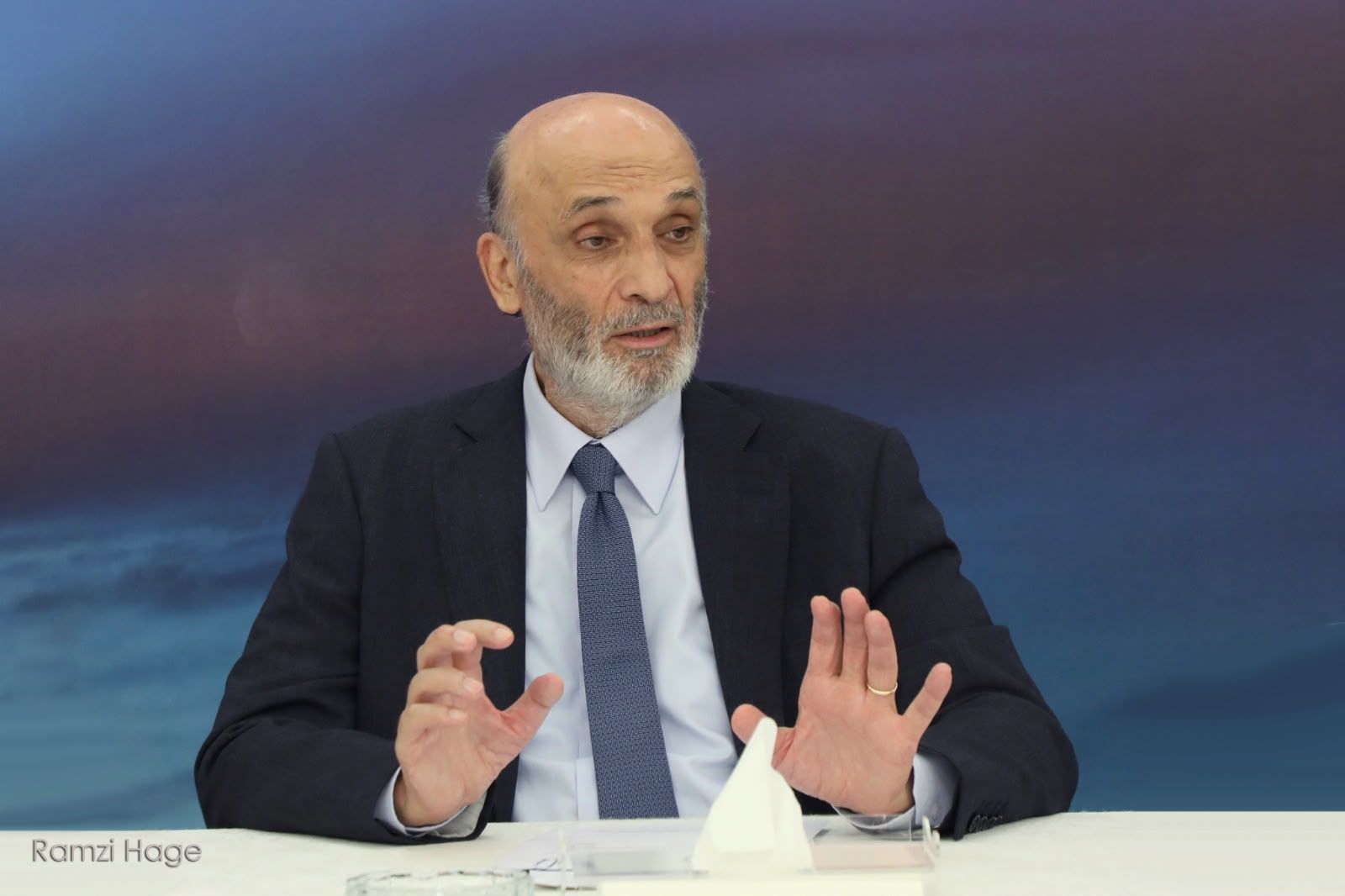
Lebanese Forces Party leader Samir Geagea said that the crisis affecting Lebanon’s electricity sector is the result of policies adopted over the past years, stressing that Lebanese citizens are still receiving what he described as “the electricity inherited from the era of Gebran Bassil.”
In an interview with Al-Massira magazine, Geagea explained that the country’s power infrastructure — including generation plants, transmission networks, and distribution systems — has not changed until today. The only difference, he said, is that these facilities are now being managed more effectively, allowing citizens to receive the same number of electricity supply hours as before, but without the current government spending “a single penny” from the state treasury on the sector.
Geagea stressed that solving Lebanon’s electricity crisis cannot be achieved through administrative decisions or decrees, noting that the sector depends on massive infrastructure. “Electricity is about power plants, distribution networks, and infrastructure. It is not a matter of moving a matchstick from one place to another or issuing a decree to solve the crisis,” he said.
He reiterated that “the electricity people are receiving today is still Gebran Bassil’s electricity,” arguing that Lebanon still operates with the same plants, the same networks, and the same conditions, but under better management. He added that since the current government assumed responsibility, “not a single penny has been spent from the state treasury on electricity,” challenging anyone who claims otherwise to provide documents proving it.
Geagea pointed out that the continuation of the crisis is not due to the failure of the current Energy Ministry administration, but rather to the lack of financial resources needed for major investments. He recalled that the electricity sector had drained “at least $30 billion from the state treasury over the past fifteen years,” while Lebanese citizens continued to suffer from the same problem.
He argued that the real solution begins with involving the private sector in electricity generation and management, saying: “As long as this sector remains managed by the state, the problem will not be solved.” He revealed that the Energy Ministry and its team have spent recent months completing the legal and regulatory requirements to establish the electricity regulatory authority and prepare investment frameworks, paving the way for private companies to enter the sector.
Geagea described the opening of the electricity sector to private investment as “the beginning of the end of Lebanon’s electricity crisis,” stressing that there is no other path to rescue the sector.
Addressing criticism directed at Energy Minister Walid Fayad’s performance, Geagea said such criticism ignores facts and figures and relies on inaccurate comparisons between the current situation and previous years. He rejected claims that Lebanese citizens enjoyed better electricity supply when the Free Patriotic Movement controlled the ministry, saying that the state was then paying around $1 billion annually while electricity services remained almost unchanged.
“The claim that electricity cost the treasury a billion dollars but provided better service is completely false,” Geagea said, adding that supply hours remain the same today, but with “zero cost” to the state treasury.
He stressed that money spent from the treasury is ultimately Lebanese citizens’ money, saying: “The treasury is your pocket, and when money is paid from it, you are the ones paying.”
Regarding previous international offers to build power plants, Geagea said such proposals existed in the past but are no longer available due to Lebanon’s financial collapse. He said companies such as Siemens and General Motors had shown interest in investing in electricity projects under the BOT system, benefiting from Lebanon’s ability at the time to provide sovereign guarantees.
“Today, Lebanon is a bankrupt state and cannot provide such guarantees, which is why companies are no longer willing to invest under the previous conditions,” he explained.
Geagea added that the Energy Ministry has continued efforts to attract foreign investors, including through visits and contacts in the United States, France, Saudi Arabia, Qatar, the UAE, and other Gulf countries. However, he said these efforts faced the obstacle of Lebanon’s inability to provide the required guarantees.
He explained that the regulatory authority has therefore adopted a new approach, allowing private investors to both produce and distribute electricity, giving them an economic guarantee through their ability to collect revenues directly.
Geagea also criticized the Free Patriotic Movement’s criticism of the current electricity policy, saying that after fifteen years of managing the sector, “they are the last ones entitled to speak about electricity.” He argued that the infrastructure used today is the same inherited from previous administrations, with the difference being in management.
He acknowledged that citizens have the right to demand better electricity services, but said responsibility must be directed toward those who brought the sector to its current state. He described opening the sector to private investment as the most important reform that should have been implemented years ago.
Geagea also addressed what he called the “deep state” within public administrations, saying that obstacles to electricity reform are not only financial and technical but also administrative. He cited delays affecting the electricity regulatory authority, whose members, despite their expertise, worked for months without receiving salaries due to administrative procedures.
He further revealed that many state institutions have failed to pay their electricity bills to Électricité du Liban, while ordinary citizens face strict measures when they fail to pay. He said outstanding public-sector debts amount to around $250 million, while exemptions granted to the South Council have created additional financial burdens estimated between $150 million and $200 million.
Geagea warned that continued delays in paying state debts could prevent Électricité du Liban from purchasing fuel needed to maintain electricity supply.
He also questioned whether some administrative obstacles were merely the result of negligence or attempts to obstruct the current Energy Minister’s work, saying he found no other explanation for what is happening.
On electricity imports through Syria, Geagea said the project remains technically challenging due to damage to the transmission network and previous sanctions, which had prevented progress. He added that Lebanon is also exploring alternatives, including electricity connections with Cyprus and Turkey, emphasizing that future projects must begin today in order to deliver results years later.
In conclusion, Geagea said that despite the difficult circumstances, the current Energy Ministry is working to rebuild a sector that has been severely damaged over the years. He stressed that opening the electricity sector to private investment represents “the only path to salvation” and a reform that should have been launched fifteen years ago when Lebanon’s conditions were far more favorable.
تابع آخر الأخبار أولاً بأول على قناتنا في واتساب
تابعنا